Europe and Germany are facing profound macroeconomic and geopolitical upheavals that impede their path to climate neutrality. The political status quo is characterized by a fundamental tension between pursuing decarbonization on the one hand and ensuring competitiveness, macroeconomic stability, and strategic security on the other. Yet, despite growing political and societal resistance, the clean industrial transition remains a long-term necessity.
In a world increasingly driven by geopolitics, market-based instruments – once the cornerstone of European climate policy – are losing political traction and becoming less effective. While this shift requires a recalibration of existing tools, it also opens new avenues for policymakers. The clean transition can only be achieved by moving beyond the isolated and one-dimensional policy approaches of the past. Moving forward, decarbonization must be consistently integrated into macroeconomic and security strategies.
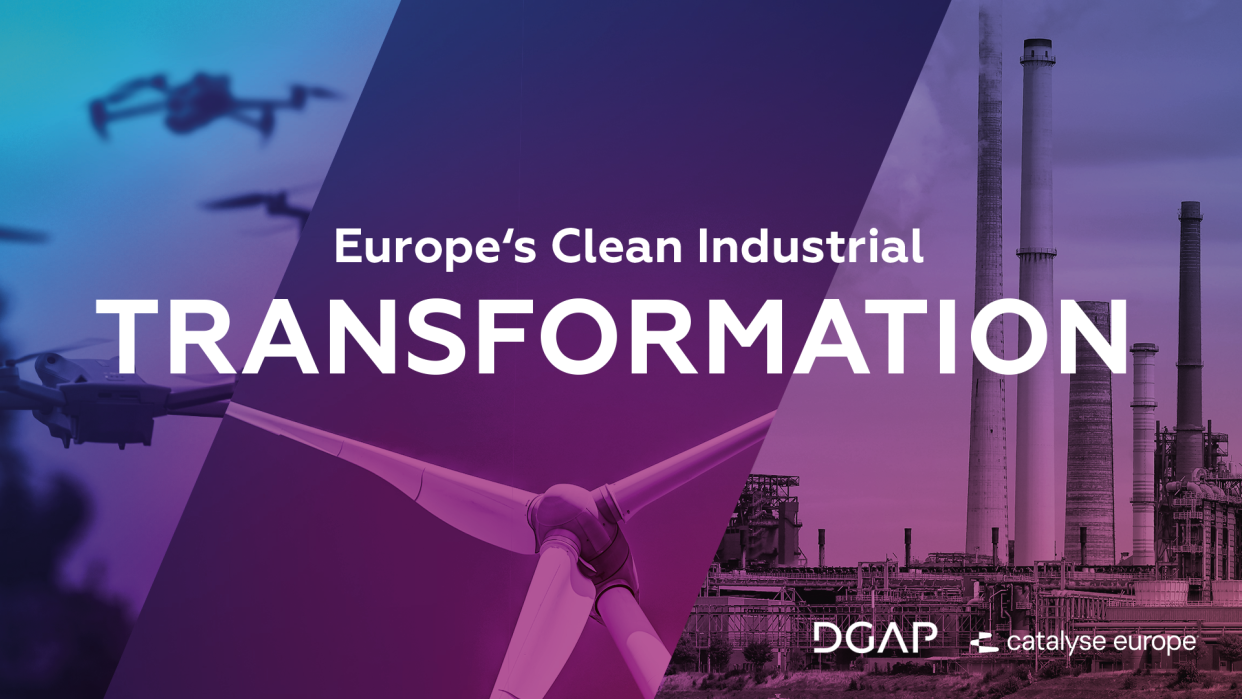
The project “The Political Economy of Europe’s Clean Industrial Transformation” is a direct response to this challenge. It will develop an integrated policy framework for the EU’s industrial transformation based on input from key stakeholders who are positioned to shape a more coherent approach. By fostering deeper institutional and thematic integration, it will strengthen the capacity for holistic policymaking, effectively breaking down silos across diverse policy fields.
Given its economic clout and central role in EU decision-making, Germany is pivotal to driving and shaping the clean industrial transition. It is also the country that stands to benefit the most from its success. Located at the heart of the German political landscape and equipped with strong European networks, the German Council on Foreign Relations (DGAP) is ideally positioned to generate this positive impact.
The project “The Political Economy of Europe’s Clean Industrial Transformation” is funded by Catalyse Europe and implemented by DGAP’s Europe Center.
Share
Experts