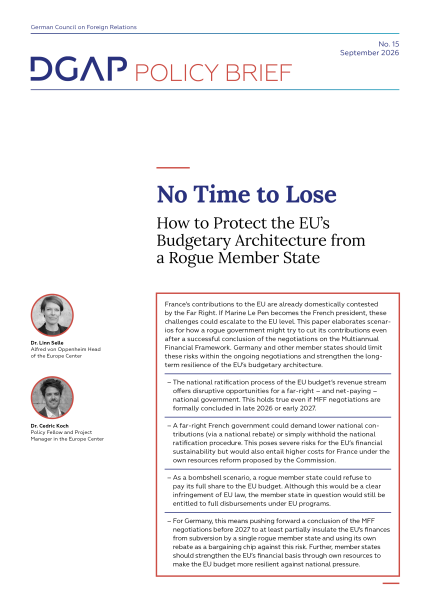
| The national ratification process of the EU budget’s revenue stream offers disruptive opportunities for a far-right – and net-paying – national government. This holds true even if MFF negotiations are formally concluded in late 2026 or early 2027. |
| A far-right French government could demand lower national contributions (via a national rebate) or simply withhold the national ratification procedure. This poses severe risks for the EU’s financial sustainability but would also entail higher costs for France under the own resources reform proposed by the Commission. |
| As a bombshell scenario, a rogue member state could refuse to pay its full share to the EU budget. Although this would be a clear infringement of EU law, the member state in question would still be entitled to full disbursements under EU programs. |
| For Germany, this means pushing forward a conclusion of the MFF negotiations before 2027 to at least partially insulate the EU’s finances from subversion by a single rogue member state and using its own rebate as a bargaining chip against this risk. Further, member states should strengthen the EU’s financial basis through own resources to make the EU budget more resilient against national pressure. |
Below you will find the online version of this text. Please download the PDF version to access all citations.
In June 2026, party leader Jordan Bardella claimed that the far-right National Rally (Rassemblement National, RN) “will give the French their money back […] because France is destined to make itself respected and defend its interests.” Although France is a net payer to the EU budget, it is also a major beneficiary of EU money. Agricultural subsidies make up 58 percent of France’s returns from the EU budget, yet the RN has contested the country’s annual contributions domestically for years. In a recent presidential debate, RN candidate Marine Le Pen underlined that she wanted to cut French contributions by €5 billion per year. This contestation might gain new relevance if the RN wins the presidential election next year. In fact, this possibility is one of the reasons why the president of the Council of the European Union aims to wrap up current budgetary negotiations around the Multiannual Financial Framework (MFF) – referred to by many as the mother of all negotiations – by the end of this year and before a big electoral season starts in the EU in spring 2027.
In this DGAP Policy Brief, we elaborate three scenarios for how a French government led by the RN could try to “cut in half” its national contributions even after the conclusion of negotiations on the MFF. Although these scenarios build upon the domestic French debate, they might not be unique to France: Given the electoral calendar for 2027, far-right forces deeply skeptical about the EU’s budgetary architecture might also come to power in other EU member states. Therefore, it is essential to prepare to safeguard the EU budget and its programs from such political pressure.
For Germany, this means pushing for the conclusion of MFF negotiations by the end of this year to enable national ratification processes in all EU member states ahead of those crucial elections – thereby insulating the EU’s finances at least partly against destabilization from a single rogue member state. Furthermore, Germany and like-minded member states should strengthen the EU’s financial base via new “own resources” – EU revenue streams that do not come from member states – to make the EU budget more resilient against national political pressure.
EU Budget Negotiations Do Not End with the MFF
In June 2024, Jordan Bardella, then on the campaign trail in a bid to become France’s prime minister, already claimed the RN would cut the French contribution to the EU budget by “between €2 billion and €3 billion” (10 to 15 percent of the French contribution in 2024). In June 2026, eyeing a RN presidency, he advocated for cutting France’s contribution in half. This would mean a reduction of roughly €12 billion annually that would either need to be cut from the EU’s annual budget (of currently €190 billion) or shouldered by other member states (roughly a quarter by Germany).
The EU budget negotiations count among the most controversial ones in the European Union. However, in the past, even member states like Hungary folded their vetoes in the end because EU money accounts for sizeable portions of investments at national level. In principle, France, being a net payer to the EU budget, is in a different position – although agricultural support is by far the biggest for the country compared to other member states.
Assessing how a far-right government could undermine the EU’s budgetary architecture needs to look beyond the MFF negotiations alone: Even if a new Multiannual Financial Framework – governing the expenditure of the budget and defining which programs get how much money – is agreed by year’s end, this does not end the EU’s budgetary process. The budget’s revenues need to be ratified by every member state before new levels of national contributions can take effect. Also, potential new “own resources” would need to be decided (by unanimity) in the European Council and ratified in the same procedure before they can be collected through the European Commission or the member states. Under its current proposal, the Commission aims to introduce a broad range of new funding streams to alleviate national contributions based on gross national income (GNI).
Usually, this national ratification process runs through the first months of a new MFF period and is then retroactively applied. In the current budgetary cycle, for example, joint EU borrowing for the NextGenerationEU pandemic recovery instrument (NGEU), which came with an increase of the EU’s own resources ceiling by 0.6 percentage points, came into effect months later than initially planned. This was because Germany had to wait for a decision by its Federal Constitutional Court before it could ratify the Own Resources Decision (ORD). Therefore, this double process – EU-level negotiations on the MFF on the expenditure side and its revenues as well as national ratification of the budget’s revenue streams – creates an additional venue for political deliberation and, potentially, tension.
In the following sections, we elaborate three scenarios of how a far-right government could call its budgetary contributions into question, taking a potential RN government as an example. Such a government could seek to significantly lower French contributions through the national ratification process of the EU’s revenue stream to try to hold the EU’s budgetary process hostage (Scenario 1and 2). Furthermore, even if both the MFF Regulation and the Own Resources Decision are adopted ahead of the EU’s super election year in 2027, a rogue government could stop paying parts of its contributions to the budget – what we refer to as the bombshell option (Scenario 3).
Scenario 1: Delay the Process to Renegotiate the National Share
Even if the MFF is agreed before France’s presidential and parliamentary elections in April 2026, a new French government might be inclined to reopen the EU budgetary negotiations once it takes power. Today, both budget hawks and the Far Right have already made France’s national contributions part of a contested domestic political debate. Consequently, any new government – whether led by the RN or not – might feel pressure to reopen the discussion on how much France pays.
In France, ratification of the Own Resources Decision (ORD) must be done by both parliamentary chambers. The length and complexity of this process could result in a debate to reduce France’s share of the EU budget, for example through demand for a rebate. A rebate that is – at least under the current MFF – credited to Germany, the Netherlands, Sweden, Austria, and Denmark as disproportionately net-paying countries. Although it is also a net payer, France (together with Italy) has not yet demanded such a rebate. This is because France is by far the biggest recipient of agricultural funding (see Footnote 2) and, in principle, in favor of a bigger EU budget.
Incidentally, the ORD proposed by the EU Commission in July 2025 foresees the abolition of the existing rebates for large net-payer countries – an issue still very much contested among member states. As it now stands, however, the Commission proposal would reduce the contribution burden of France (and all other member states aside from the five rebate countries) that currently have to shoulder the total rebate sum according to their relative economic size. The Commission’s proposed MFF and own resources packages (including the abolition of the rebate) would nonetheless increase France’s bill compared to today. This is due to the planned increase in the overall EU budget that largely finances the NGEU debt repayment, which is due from 2028 onward and accounts for inflation losses since 2021.
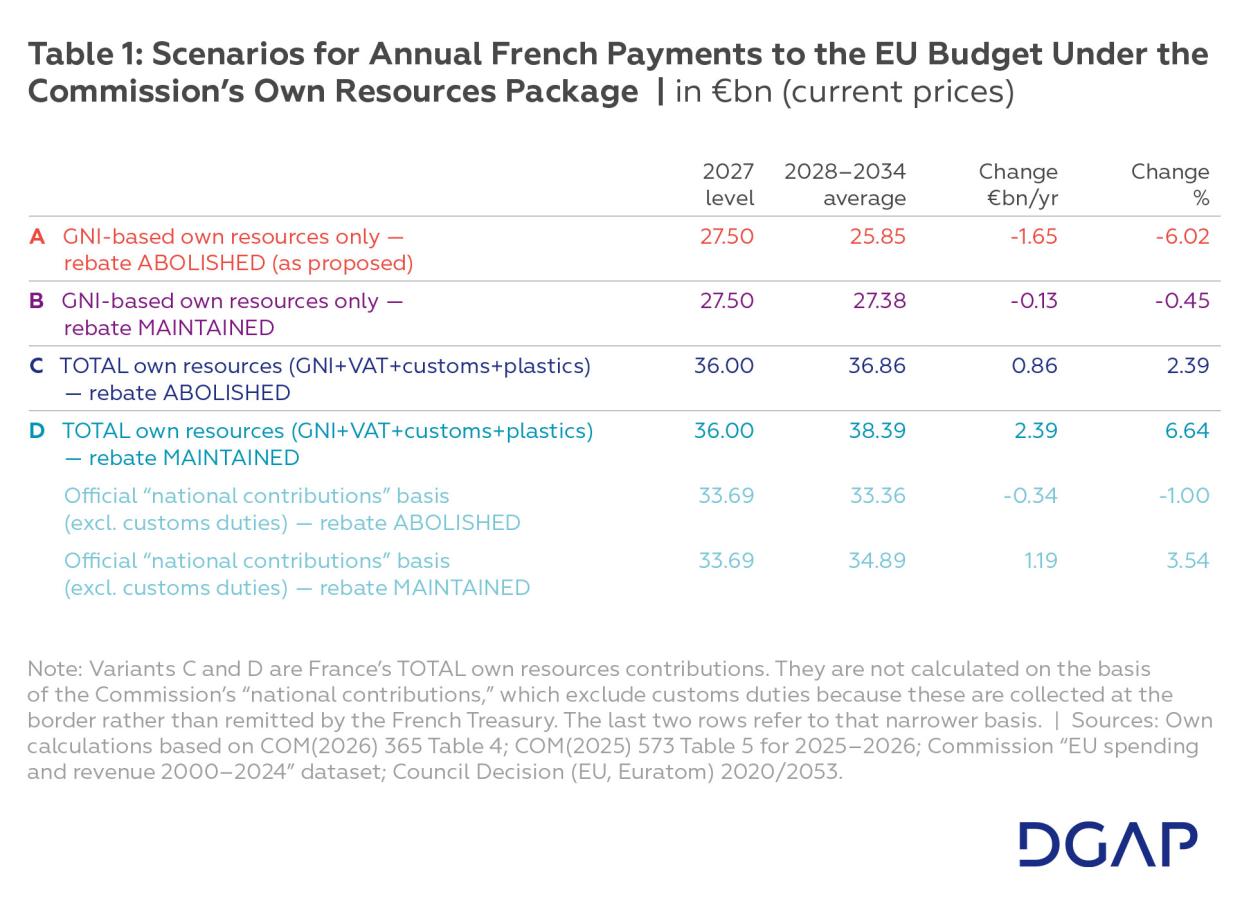
According to our estimates, France’s average annual contribution across all own resources would increase by around €0.86 billion – from €36 billion to €36.86 billion (see Table 1). Any reintroduction of national rebates would increase France’s payment burden to around €1.47 billion more per year during the next MFF. Such an increase could play into any debate on national contributions in France next year, when the RN would likely weaponize it.
Any renegotiation of a French rebate after the formal conclusion of the ORD negotiations, however, would mean a de facto reopening of the EU budget negotiations in all their complexity. Technically, such a request would imply one of two things: either that the overall MFF Regulation (the EU’s expenditure programs) needs to be reopened to cut spending and lower income from France or that other member states need to shoulder France’s share of reduced contributions to keep the legally required balance of the EU budget. In both cases, the other national ratification processes would be affected and delayed. Therefore, renegotiating France’s share via the national ratification of the ORD could lead to an underfunding of the MFF in 2028 and beyond or a generally lower MFF that would need to be renegotiated in 2027.
Scenario 2: Attempt to Freeze the EU Budget Through Non-ratification
Going beyond an ORD renegotiation, a far-right French government could simply not put forward a ratification bill of the Own Resources Decision that would fortify national payments that were higher than those under the current EU budget, attempting to freeze the EU budget at its current levels. As our analysis shows, this is currently not a likely option: If the final own resources reform package stays as favorable to France as proposed by the Commission, refusing to ratify it could hurt the French budget. Nonetheless, it would put the EU’s finances at immediate risk.
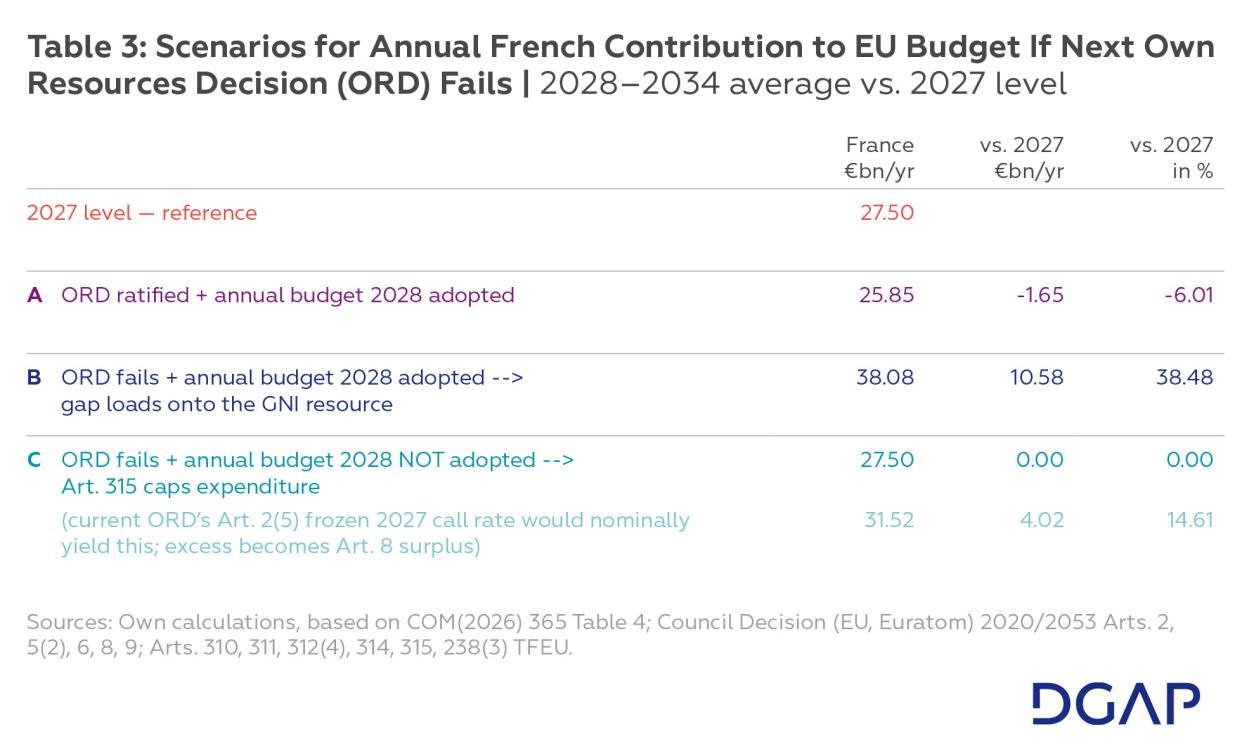
A non-ratification of the ORD after the MFF was agreed would lead to a situation where a new MFF Regulation would take effect, including its new structure, programs, and levels of spending. On the funding side, as no new ORD would come into force (because one member state has failed to ratify it), the financing of the European Union’s annual budget would fall back on the current ORD that will continue to be in effect until a new decision is ratified. Therefore, the financing of a new annual budget from 2028 onward would need to respect the contribution ceilings laid down in the current Own Resources Decision that foresees commitment appropriations of up to 1.46 percent and payment appropriations of 1.40 percent of EU GNI. It also includes an additional 0.6 percent of EU GNI (exclusively) to repay NGEU loans.
Given that the current MFF proposal of the European Commission represents payment appropriations of 1.26 percent of EU GNI, a new EU budget could, in principle, be financed via the old own resources ceilings, including the 0.11 percent of EU GNI reserved for NGEU debt repayment.
However, and in contrast to the Commission proposal, a new EU budget would then be funded much more strongly through member state contributions. That is because no new own resources would take effect to alleviate the burden of national payments. Therefore, French annual contributions would be distinctly higher – not only than in 2027 but also than under the Commission’s proposed own resource reform (see Table 2).
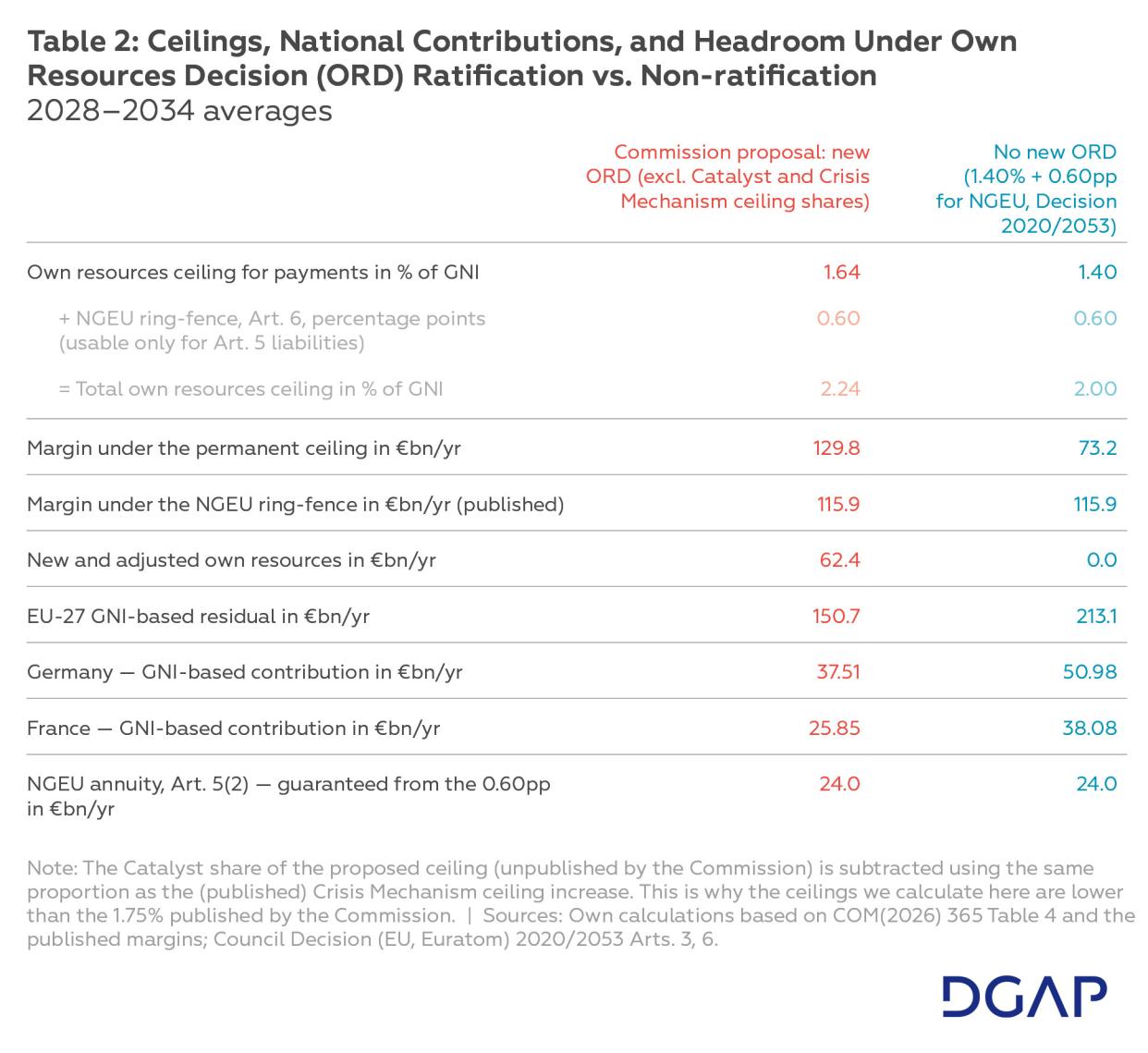
Even if, in principle, a new MFF could be financed through the old rules, it poses severe risks in the short and long term: The own resources ceiling sits well above the actual MFF spending plan because it serves as a legal safety net designed to cover the contingent liabilities of the European Union (including loan guarantees for NGEU, Security Action for Europe (SAFE), macro-financial assistance (MFA), and Ukraine loans). This is needed due to the time lag between multiyear commitments and their eventual payments. It can also reassure bond markets that the EU can mobilize enough resources to service its debt – even in an economic downturn or when a member state defaults on payment, which has become especially important since the large-scale debt emission for NGEU. Any reduction in this legal safety net is likely to translate into higher financing costs for the EU, including in refinancing existing bonds. Therefore, as the margin between actual payments and theoretical commitments would be squeezed to only 0.14 percent, this poses a direct threat to the financing conditions and liquidity of the European Union.
Non-ratification and Blocking Minority in the Council
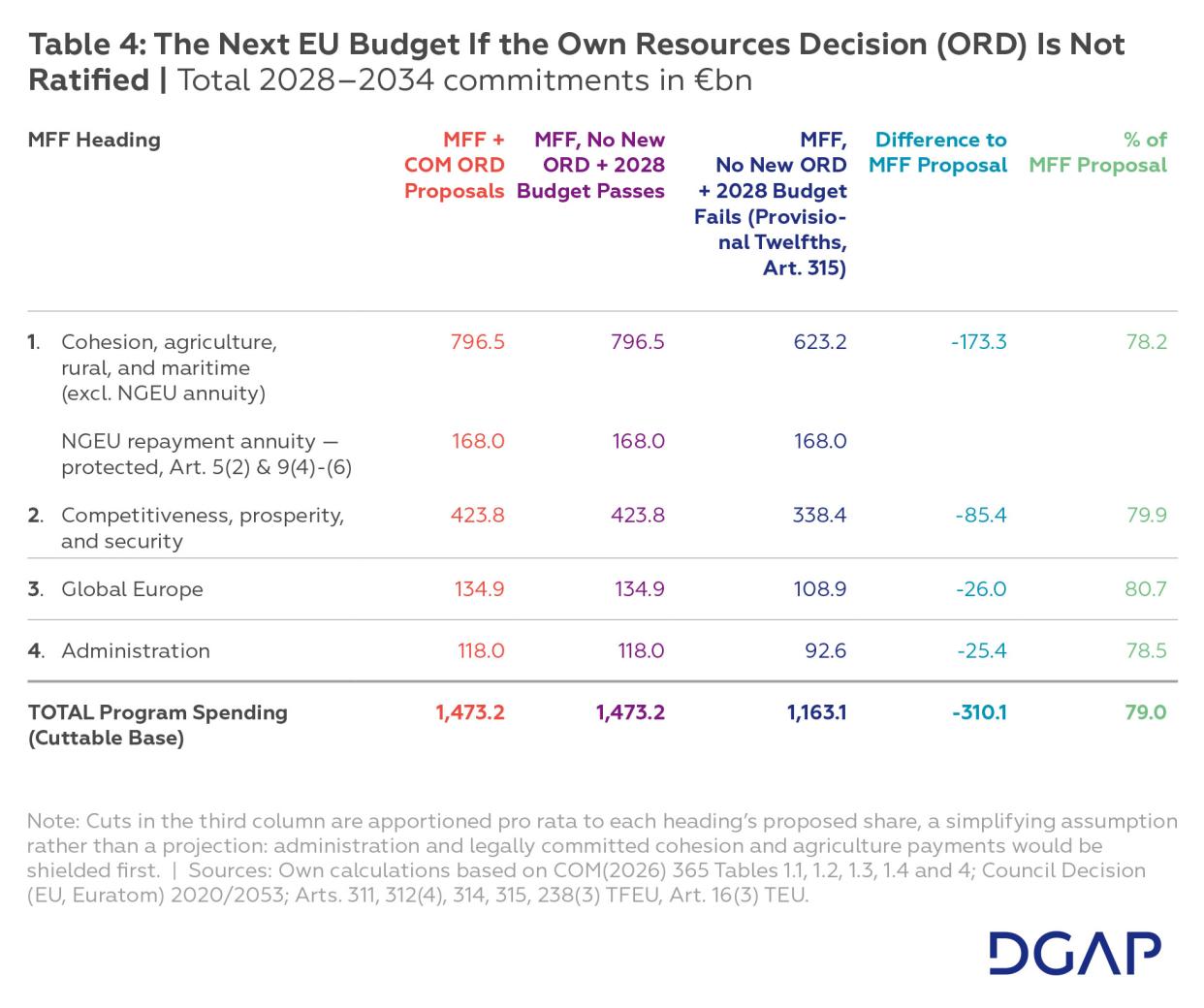
A second and potentially more severe version of this scenario could result in 2028 if, in addition to a non-ratification of an ORD, no annual budget would be agreed between the Council and European Parliament (the co-decision procedure only gives France the option to form a blocking minority together with other member states rather than a full veto). In such a case, Article 315 of the Treaty on the Functioning of the European Union (TFEU) foresees that the financing of the EU falls back to a funding level based on the previous year’s level, where monthly expenses of up to one twelfth of that year’s budget can be taken. These “provisional twelfths” can be expanded by Council decision but are not allowed to exceed the total sum of the previous year’s expenses.
If such a scenario kicked in, the consequences for the EU’s finances look dire. The new structure and programs of the EU budget (which would have already been agreed under the MFF Regulation) would need to be financed through the old (2027) level of expenditures. This would lead to severe cuts in all areas of the budget (see Table 3). Moreover, although the European Parliament’s centrist parties can overrule such a blocking minority of the Council with a three-fifths majority, four member states representing 35 percent of the EU’s population could do major damage to the budgetary process.
The scenario of non-ratification shows that – even in the case of a political decision of one member state to not put forward a ratification bill of the Own Resources Decision – a newly structured multiyear budget could, in principle, take effect. But the consequences could be grave: As the European Union is legally bound to a balanced budget, it only has leeway of 0.14 percent EU GNI to address unforeseen costs, crises, and lending. This lack of wiggle room, the so-called headroom, poses severe and potentially immediate risk to the EU’s financial architecture. One non-ratification on the member state level could stop high national contributions under a new MFF as long as the “provisional twelfths” rule does not take effect. Yet, for now, this scenario seems unrealistic given the majorities in both the Council and – more importantly given next year’s electoral calendar – in the European Parliament, which serves as a backstop to a Council blockage.
Scenario 3: Unilaterally Cut National Contributions, a.k.a. “The Bombshell”
To cut France’s contribution to the EU budget in half, as Jordan Bardella promised on the campaign trail this year, a far-right government could be inclined to simply stop paying a part of its share of national contributions to the European Union – amounting to around €27.5 billion annual GNI-based payments by 2027 that are set to increase in the next MFF (see Table 1). Although the European Union has strengthened its legal safeguards in the past years to protect the EU budget from rogue member states, our analysis below shows that, in fact, the EU has very few instruments at hand today to address such a blatant disrespect of EU law and national commitments to the Union.
First, a non-payment of GNI contributions to the European Commission would automatically lead to late payment interest fines that are tied to the European Central Bank’s refinancing rate and increase as a “penalty rate” each month by 0.25 percentage points. These fines function as a deterrent to fiscal noncompliance but, similar to the national contributions themselves, they cannot be automatically collected by the European Commission. Instead, the fines need to be disbursed by the (non-paying) member state. Furthermore, the missing funds cannot simply be deducted from Commission disbursements to that member state because the EU Financial Regulation explicitly excludes the collection of own resources, including the national GNI-based contributions, directly through the Commission, which would enable a deduction from existing programs.
As the European Commission cannot simply cut payments under MFF programs, one might think of Rule of Law Conditionality as another way to address such a scenario. This instrument was set up in 2021 and was meant to safeguard the EU’s financial interests against rogue member states. However, for Rule of Law Conditionality to kick in, two elements are required. First, that a breach of the principles of the rule of law occur in a member state and, second, that this breach affects, or seriously risks affecting, the sound financial management of the European Union’s budget or its financial interests in a sufficiently direct way. While the financial interests of the European Union would be clearly and directly affected by a discontinuation of national payments, it might be harder to establish a link to rule of law breaches. That is because the regulation defines breaches of rule of law as, among other things, lack of judicial independence, failure to prevent arbitrary/unlawful decisions, and lack of effective judicial review. A formally correct law to cut French contributions to the EU budget would, therefore, not define itself as a breach of domestic rule of law processes per se because they then might be disputed under the regulation.
The same holds true for the specific rule of law mechanism of the newly created National and Regional Partnership Plans (NRPPs) which will – most likely – govern the distribution of agricultural and cohesion funds in the next EU budget. As 58 percent of France’s disbursements from the MFF currently go into direct payments for farmers and agricultural support, this instrument is highly relevant for the citizens of France, including key RN constituencies in the French countryside. Under the NRPP framework, the Commission could suspend the whole program (including all agricultural and cohesion payments) if serious breaches of the rule of law occur. However, the fact that breaches need to be established for individual NRPP funds makes it rather unlikely that the instrument can be used in this scenario.
Therefore, it is not self-evident that a government’s political decision to stop transferring its GNI contributions – even though it is an unambiguous breach of EU law and of the principle of sincere cooperation – is a rule-of-law breach that could trigger a request from the European Commission to the Council for a discontinuation of EU funds. Consequently, France would still be eligible to full payments from the next MFF.
Instead, as a first step, the European Commission could send a reasoned opinion to the French government to start a regular infringement procedure to bring the case before the European Court of Justice (CJEU). As the provision of own resources is essential to the functioning of the Union as a whole, a non-payment not only affects the European Commission but also, potentially, all other member states as well as the Union’s overall capacity to act. Therefore, such an infringement procedure would likely also entail the claim of a breach of sincere cooperation under Article 4.3 of the Treaty on European Union; it has already been employed in previous cases around the collection of own resources through member states.
Recommendations for Germany and the EU
Although hypothetical in nature and dependent on the outcome of the French elections and other national elections that are still largely open at the time of this writing, the elaborated scenarios underline where a far-right – and net-contributing – government might undermine the EU’s budgetary architecture. As the European Union is not allowed to spend anything more than is decided in the Own Resources Decision (ORD), undermining this legal act or unilaterally changing one’s national contribution poses serious risks to the EU’s financial architecture. Therefore, it is not only the closure of the Multiannual Financial Framework (MFF) negotiations that must be considered but the whole process of budgetary negotiations and ratification processes.
The three scenarios show that, even in the event of a successful conclusion of the MFF negotiations in late 2026, a rogue national government could try to derail the EU’s budgetary process. This would be unprecedented. Despite those negotiations being among the most complex and politically intense on the EU level, its outcomes have, so far, always been respected – even by member states strongly critical of the EU. One reason for this is that, in the end, the assessment prevailed that member states would materially gain more than they might lose. This even holds true for the previous Hungarian government under Prime Minister Viktor Orbán. Although that government was highly critical of the newly introduced Rule of Law Conditionality in the MFF, it gave up its veto in the end to conclude the negotiation process.
In principle, the European Union’s budgetary system has been built to be resilient against a rogue member state aiming to take the ratification of the ORD hostage. Although the national ratification process can be used to demand changes to national contributions such as a national rebate, a fully-fledged non-ratification would lead to even higher national contributions for France under the own resources reform proposed by the Commission – and is, thus, not in its interest. In theory, a newly structured EU budget could be financed through the old revenue system, but it would pose a serious threat to the EU’s financial stability.
What we call the bombshell scenario (a unilateral cut of national contributions) would obviously be the most far-reaching attempt to lower national payments. As a blatant infringement of the EU’s legal order, such a move would certainly burn bridges with EU institutions and the other member states. Therefore, it is regarded as the least likely scenario. However, beyond a formal infringement procedure in front of the European Court of Justice, the European Union does not currently hold distinct budgetary instruments – such as discarding funds to that member state or initiating a rule of law procedure – to react to such a move.
Against this background, we see three primary implications for the German government and EU for the further negotiation process toward the EU’s next multiannual budget and beyond:
First, it is of critical importance that, at the upcoming meetings of the European Council, a swift agreement on the expenditure side of the EU’s finances (the Multiannual Financial Framework), is reached by the end of 2026. This would enable the national ratification of the ORD ahead of 2027’s elections that would, in turn, prevent a renegotiation or a risk of rising liquidity and refinancing costs for the EU budget (as in Scenarios 1 and 2). If an MFF agreement – which, contrary to the 2028 annual budget procedure, needs unanimity – is not secured before the national elections of 2027, the room for a single rogue member state to derail the EU’s finances would increase strongly.
Second, Germany and other net paying member states should carefully consider whether to insist on keeping their national rebates. Doing so might open demands for further rebates from rogue member states even after the conclusion of the MFF negotiations. Instead, we recommend that Germany offers the abolition of its own rebate now and thereby obtains a bargaining chip to hold against potential rogue state rebate claims next year.
Third, to become more resilient from potential rogue member states, the German government should support the creation of new own resources that independently fund the budget and are less dependent on political fault lines inside member states. Such national contributions form steady and predictable flows of income to the EU budget and reflect the economic performance of member states. However, the high level of GNI contributions, which amount to two thirds of the EU budget’s revenue today, pose a systemic risk in an EU with a potentially growing number of rogue member states.