This is an excerpt from the report “The Revenue Side of the Next EU Budget: A Path to Unlocking an MFF Agreement Before 2027”.To access the full text (including footnotes), please download the PDF.
Negotiations on the Multiannual Financial Framework (MFF) 2028–2034 have focused almost entirely on the EU budget’s structure and volume. This has left the revenue side largely unaddressed despite member states (especially Germany) desperately seeking a deal before the EU’s “super election year” in 2027 – when eight EU countries hold national elections with potentially serious consequences for EU finances.
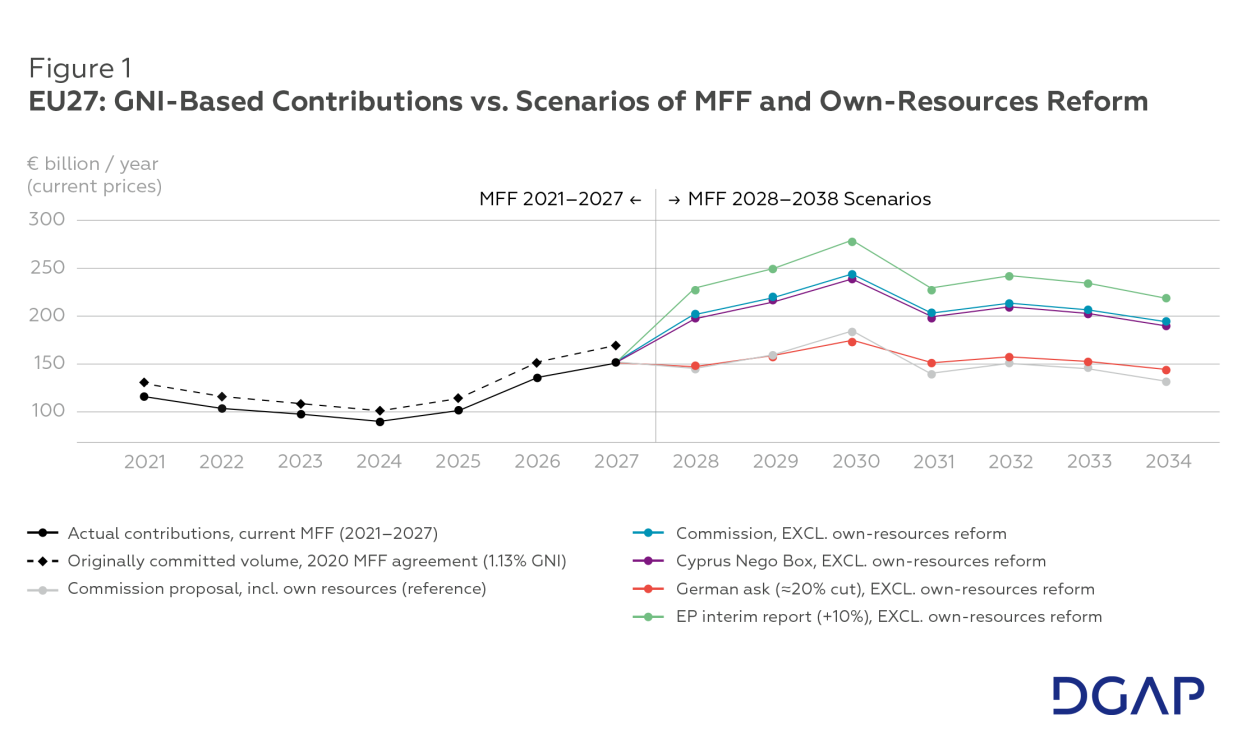
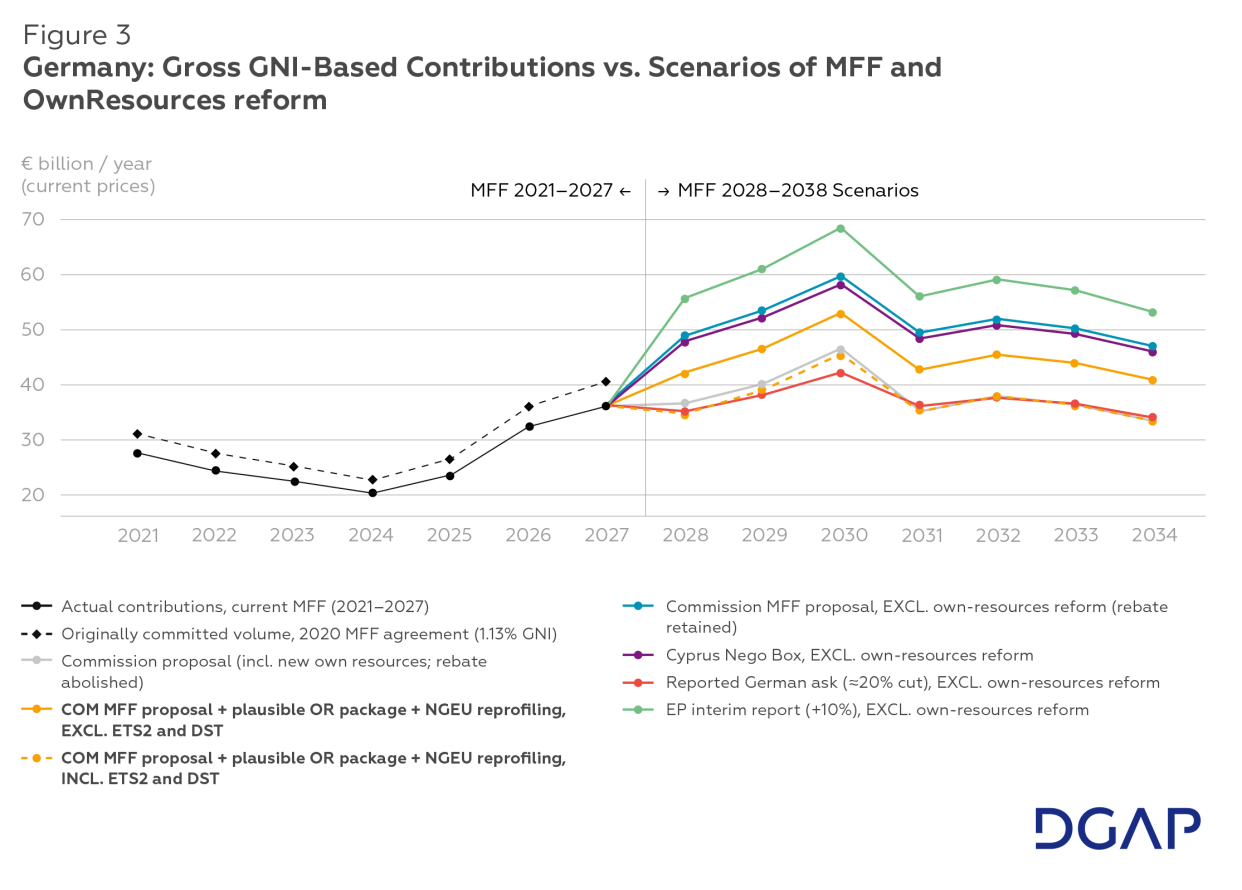
Yet, a wide gap still separates the negotiating positions on the size of the next MFF: the Commission’s proposal (€1,763 billion, 2025 prices), the European Parliament’s +10% demand, the Cypriot Presidency’s nego-box proposing -2%, and Germany’s demand for a ~20% cut. Under the current revenue system, closing that gap would require between €24 billion and €127 billion in additional annual member-state contributions EU-wide versus 2027 (current prices, see Figure 1) and €6 billion to €32 billion more from Germany alone.
Such increases seem untenable to key states including Germany at a time of fiscal consolidation. Yet cuts of this magnitude also seem implausible: Strong interests protect spending on agriculture in the European Parliament’s and Council’s largest party, the EPP, and cohesion among most member states and German regions. Cuts have therefore so far mainly fallen on the European Competitiveness Fund – exactly the modernizing MFF pillar Germany seeks to protect most.
This paper argues that instead of expenditure cuts alone, a package deal including own-resources reform and smarter repayment of NGEU Covid-recovery debt offers the most realistic path to an MFF deal before 2027.
Two Revenue Levers to Help Close the Gap
1. A plausible own-resources package: Of the own-resource reforms under discussion, only elements that raise new revenue or reallocate existing member-state funding from net payers to others would help close the gap:
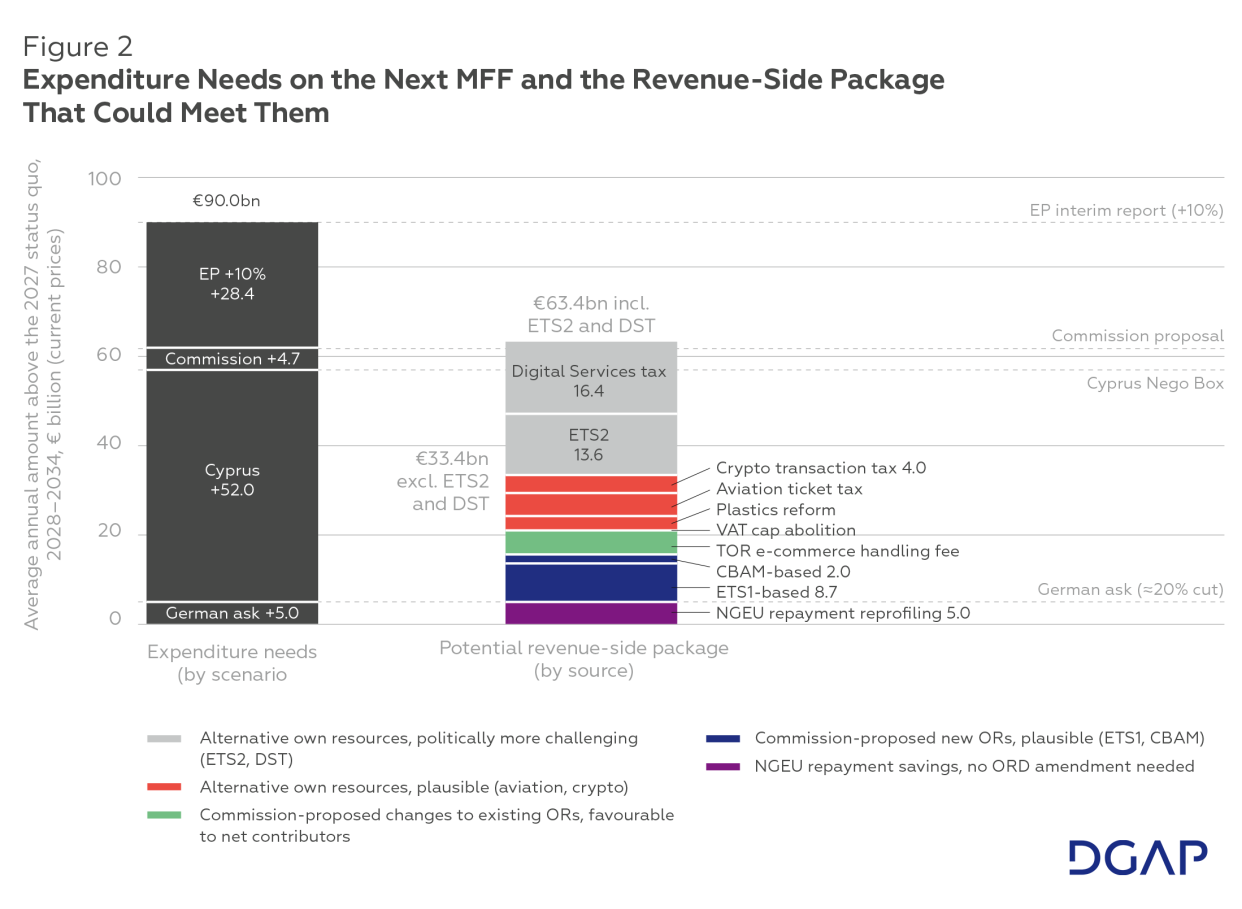
- Three elements from the Commission’s July 2025 package (ETS1 share, CBAM share, e-commerce handling fee): ~€16 billion/year is plausible, or ~€19 billion including the VAT cap abolition and the plastics reform, which have politically favorable distributional effects, versus the Commission’s €64.4bn estimate.
- Two further viable candidates could add ~€9 billion/year: an aviation tax and a crypto transaction tax. An ETS2-based resource and a digital services tax (DST) are politically harder but could add ~€30 billion/year.
- Excluding ETS2 and the DST, this package could generate ~€28 billion/year, or ~€58 billion with both included.
2. Smarter NGEU debt repayment: The 2020 Own Resources Decision permits several alternative repayment schedules without requiring unanimous amendment.
- Reprofiling the NGEU could free up to €35 billion in 2028–2034 (cutting the MFF’s debt-service bill by about a fifth, measured against the Commission’s own proposed repayment profile) while smoothing burdens more fairly across generations and over the next MFF, at the cost of a modestly higher bill by 2058.
A Plausible Package Deal for the Next MFF?
Even excluding the two politically challenging resources, the combined revenue-side package (~€33 billion/year) would fully cover Germany’s negotiating position and just over half of the Cyprus proposal (see Figure 2). With an ETS2-based resource and digital services tax (~€63 billion/year), it would clear the Cyprus proposal by ~€6 billion and even exceed the Commission’s expenditure proposal by ~€2 billion, leaving a gap only to the EP’s more ambitious demands. While all sides will need to give way for a final deal, the two revenue-side levers can help open a credible path to an MFF agreement before 2027.
What This Means for Germany
Applying a realistic own-resources package and NGEU reprofiling to the Commission’s expenditure proposal would bridge nearly half the gap between the German expenditure position and the Commission’s MFF proposal (see Figure 3). Counting EU payments that flow back to Germany, “net” German payments would return to below their 2027 level with this revenue-side package. If an ETS2-based resource and a DST are also agreed, German contributions would remain broadly at the level implied by Germany’s expenditure negotiating position while financing the Commission’s full MFF proposal. Under this scenario, net German contributions would even fall back toward their 2021 level by 2034.
Instead of mainly demanding cuts to control national contributions, Germany should actively support these options on the revenue side of the MFF which are also advantageous for the federal budget – and thereby help advance an agreement also on the expenditure side before the end of 2026.
For further details, please refer to the appendix in the download section.