| Polar science is vital to understanding planetary systems that include sea level rise, ocean health and circulation, paleoclimate, weather patterns, permafrost thaw and its related carbon impact, whale migration, and space physics. |
| Geopolitics in the Arctic have changed dramatically. Cooperation around Antarctic issues, while less politicized, have also been rendered more difficult. |
| With preparations for the International Polar Year underway, Germany should use its weight as a polar science power to strengthen cooperation on understanding and managing Arctic and Antarctic change with likeminded states. |
Below you will find the online version of this text. Please download the PDF version to access all citations.
The polar regions are particularly vulnerable to climate warming. They are undergoing rapid changes, many of which are occurring faster than predicted. These changes not only affect polar ecosystems and Arctic societies but also have far reaching global consequences, including sea level rise. Global weather patterns are also affected, for example through changes in the jet stream. The increasing speed and intensity of these changes underscore the urgency for internationally coordinated research in the polar regions. Polar science investigates the Arctic and Antarctic – including their climate, environments, ecosystems, and societies (in the case of the Arctic) – to better understand the regional and global impacts of these changes and respond to them.
Against this backdrop, the research community has agreed to organize the next major International Polar Year (IPY), an extensive effort open to all nations to collaborate on cutting-edge science projects in the Arctic and Antarctic. Due to the urgency of rapidly advancing global warming in the polar regions, this fifth IPY – known as IPY-5 – will take place in 2032/2033, only 25 years after the last IPY rather than 50 years later as originally planned (see page 3 for an overview of the IPY then and now). The crucial project phase for IPY-5 started in November 2026, which is why recent geopolitical disruptions have the potential to significantly limit global scientific collaboration around the IPY and thereby stall environmental protection efforts.
Under the second administration of President Donald Trump, the United States has backed away from science funding and collaboration – particularly in the context of climate change, which is a core concern of polar science. The Russian Federation plays a central role in the Arctic, but its war of aggression against Ukraine has resulted in political isolation. While China has invested heavily in polar science and icebreaker logistics, deepening collaboration with the country is controversial due to China’s support for Russia in the context of the war against Ukraine, its cooperation with Russia in the Arctic, and its global geoeconomic ambitions.
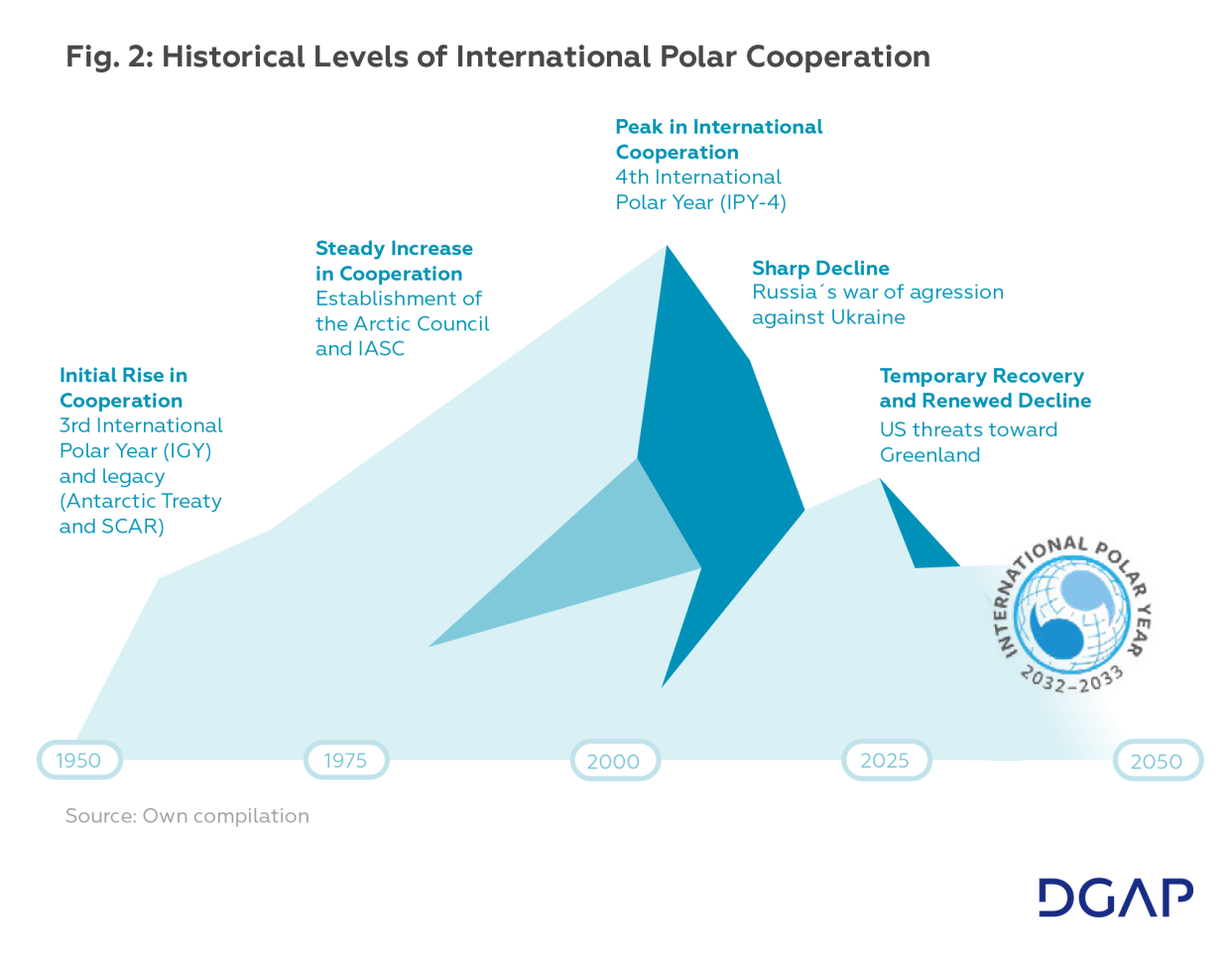
Historically, IPY has allowed for international collaboration even among countries that are at odds on political issues. However, amid the fifth year of Russia’s war against Ukraine and a heavily changing global order, polar science diplomacy is under threat. Meanwhile, the growing concern of key countries with national security and geoeconomic interests – coupled with a shift away from climate protection – is hampering international cooperation.
The nature of the IPY is multilateral and therefore open to all countries. However, with polar science becoming more geopolitically charged, the participating countries need to account for new realities. We argue here that participating countries should not exclude countries from the IPY. Instead, they should retain the freedom to decide with whom to cooperate, recognizing that project design and partnership may be influenced by political considerations. This project-oriented approach with diverse collaboration models would make the IPY as open as possible and as restricted as necessary.
Countries with a historic commitment to open science, like Germany, need to take into consideration the ways in which others may use the IPY to further geopolitical or economic interests around the poles. As a result, it is important to understand and manage these polar geopolitics to create an atmosphere in which governments will wish to fund research for positive purposes that promote scientific progress and discoveries. Success is vital: The international community urgently needs to use the best available science to develop global climate policy and strengthen local environmental protection at the poles.
Why think about this now when relations among states may look quite different by the time IPY-5 starts in 2032? Planning and funding for research happens many years in advance based on current circumstances. The future course for polar science collaboration is being set today. This DGAP Policy Brief describes the geopolitical tensions among three large powers – China, Russia, and the United States – in the context of the IPY and proposes ways to navigate them.
The IPY Then and Now
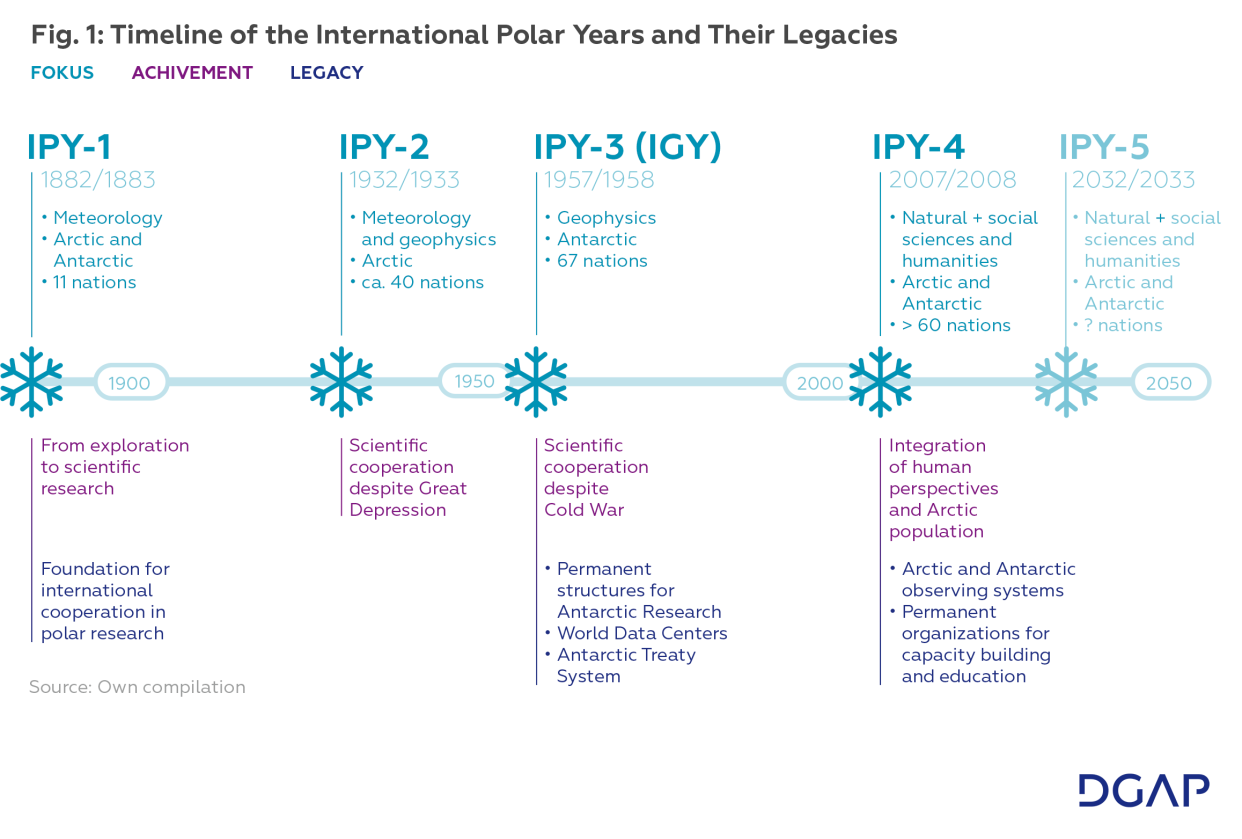
For over 140 years, the collaborations of the International Polar Year (IPY) have demonstrated how important polar science is for the international community. Over the past decades, IPY’s significance has increased as the need to study and adapt to climate change has intensified.
IPY-1, which took place in 1882/1883, was initiated by the Austro-Hungarian naval officer Karl Weyprecht. As the first internationally coordinated program of polar research and observations, it laid the foundation for international research collaboration in the polar regions. Focusing on meteorological observations, IPY-1 established 14 manned stations in the Arctic and Antarctic.
Building on this success, IPY-2 was organized in 1932/1933. Due to the difficult economic situation during the Great Depression, the research program was limited to the Arctic. IPY-1 and IPY-2 were sponsored by the International Meteorological Organization, which later became the World Meteorological Organization (WMO).
IPY-3, organized at the height of the Cold War, was held in 1957/1958. Later renamed the International Geophysical Year (IGY), it was sponsored by the International Council of Scientific Unions (ICSU), which is known today as the International Science Council (ICS). IPY-3 had a strong focus on Antarctic research and left a considerable scientific legacy. It is often referred to as a prime example of science diplomacy because the scientific cooperation it fostered led directly to the creation of the Antarctic Treaty.
IPY-4 took place in 2007/2008. Building on earlier IPYs and jointly initiated and managed by ICSU and WMO, it became the largest internationally coordinated research program in the polar regions ever. In contrast to earlier IPYs that exclusively focused on natural sciences, IPY-4 fully integrated social sciences and the humanities. IPY-4 also recognized that Indigenous Peoples are essential partners in Arctic research. It placed a strong focus on their participation and promoted the integration of Indigenous knowledge. Projects included a large number of outreach and education activities as well as efforts to coordinate data management and observations. Many of these initiatives became long-lasting structures or developed into permanent organizations.
Including both polar regions, IPY-4 facilitated cooperation and dialogue between the Arctic and Antarctic communities. A close partnership developed between the Scientific Committee on Antarctic Research (SCAR), which dates back to the IGY, and the International Arctic Science Committee (IASC), which played a leading role in managing IPY-4. There was strong political support for IPY-4 from all countries engaged in Arctic and/or Antarctic research. The Antarctic Treaty consultative parties and the members of the Arctic Council jointly adopted a declaration on the IPY and polar science.
Building on earlier IPYs, IPY-5 will take place in 2032/2033. It aims to strengthen cooperation, expand observations, work across knowledge systems, support education and outreach, and inform policy and decision-making. Initiated by IASC and SCAR and supported by the ICS, WMO, and various international polar organizations, IPY-5 seeks to foster the widest possible international collaboration to generate knowledge with direct societal impact. It emphasizes diverse, ethical, and equitable research practices for engagement and cooperation with Indigenous Peoples, supports transdisciplinary and environmentally responsible research, and encourages cooperation between Arctic and Antarctic research communities.
Based on the experience from previous IPYs, the timeline for IPY-5 includes a five-year planning phase – from 2021 to 2026 – to develop the international and national structures needed to manage such an extensive program. In particular, this planning phase served to allocate national funding and develop mechanisms to align funding for international projects. The project phase, which is slated for 2026 to 2033, has commenced and comprises IPY flagship projects, such as the Antarctica InSync initiative. It will culminate with the main IPY-5 period in 2032/2033. A legacy phase is scheduled to follow as of 2034.
Geopolitical Context and Multilateral Governance of the Polar Regions
Numerous countries participate in science at either or both poles. Each would likely contend that their primary motivation for doing so is to reap the scientific benefits of giving their researchers the opportunity to engage in cutting-edge work on the wide array of topics there. But there are other reasons as well.
Some states are located within or close to the relevant regions or have a history of exploration there. They may engage in Arctic science to find solutions for challenges faced by local and Indigenous populations in and near there. Some seek to leverage their scientific activities at the poles for economic benefit – either directly or indirectly by establishing a presence and political influence that may enhance economic prospects. Some scientific projects may veil not only geoeconomic interests in the region but also military ones.
Antarctica
In Antarctica, seven states maintain territorial claims: Argentina, Australia, Chile, France, New Zealand, Norway, and United Kingdom. These countries have taken a strong scientific and political interest in the continent and surrounding ocean. Other non-claimants also invest heavily in Antarctic research stations and related logistics. Around 30 countries operate over 70 research stations there. Sixteen of the countries that maintain Antarctic stations are European.
The objective of the Antarctic Treaty of 1959 is to promote scientific cooperation. That treaty has 58 parties, 29 of whom have consultative status because they conduct substantial research activity in Antarctica. As noted in the box on page 3, this treaty arose from the cooperation of 12 countries under the IGY (IPY-3) of 1957/1958. Another legacy of the IGY is that the Scientific Committee on Antarctic Research (SCAR) continues to coordinate research in the region.
The Arctic
Many countries have interests in the Arctic Ocean and the region as a whole. However, eight states with territory above the Arctic Circle formed the Arctic Council and maintain that they have special influence as “Arctic States”: Canada, the Kingdom of Denmark, Finland, Iceland, Norway, United States, Russia, and Sweden. Notably, about half of the Arctic’s land area and a similar percentage of its subsea areas are under Russian jurisdiction.
Other than in marine areas, science in the Arctic occurs in the domestic territories of the Arctic States – and is thus subject to their domestic laws. Science conducted by non-nationals on the land territory of the Arctic States, in territorial seas, or in the exclusive economic zone of the five Arctic Coastal States requires the permission of the relevant states and is also subject to their domestic laws. Since 1996, Arctic science has been facilitated by the Arctic Council, a high-level forum of the eight Arctic States. Recognizing the importance of promoting science, the Council sponsored negotiation of an agreement among the Arctic States on Enhancing Arctic Science Cooperation that was signed in 2017.
The International Arctic Science Committee (IASC) is a non-governmental, international scientific organization that encourages and facilitates cooperation in all aspects of Arctic research. While the Arctic Council only allows non-Arctic states to participate as observers, IASC does not distinguish between Arctic and non-Arctic states. All 25 countries conducting Arctic research are full members.
Unlike Antarctica, the Arctic is home to 4 million people, about 10 percent of whom are Indigenous Peoples who have lived in the region for millennia and have adapted to the environmental conditions. Guided by the principle “Nothing about without us,” Indigenous Peoples are recognized as rights holders, knowledge holders, and research partners. Today, researchers seek to co-design and co-produce Arctic research with Indigenous partners. Indigenous knowledge is considered a distinct and valuable knowledge system.
National Research Interests in the Polar Regions
Operating in the harsh environments of both poles involves massive costs and complicated logistics. The national research programs of countries like the United States, Norway, Germany, or United Kingdom tend to take the lead in organizing research at both poles. These national programs align their policies with the priorities of their central governments; unlike independent scientists or universities, they tend to be subject to foreign policy direction from foreign affairs ministries that take geopolitical concerns into account.
Here, we will primarily examine the research interests of the three large powers that shape the geopolitical tensions in the polar regions: the Russian Federation, the United States, and China.
The Russian Federation
Fifty-three percent of the Arctic Ocean’s coastline belongs to the Russian Federation, and nearly 50 percent of the total Arctic population lives in its territory. Russia not only has a large exclusive economic zone (EEZ) in that ocean but also claims the most extensive extended continental shelf rights of any nation. Russia sees itself as a major, if not the most significant, Arctic State. At the same time, it is also one of the most influential countries in Antarctica. While not an Antarctic claimant, Russia – like the United States – historically maintains a “basis” for a claim to the entire continent. Further, it operates bases throughout Antarctica.
Following its full-scale invasion of Ukraine in 2022, Russia has been subject to sanctions and other forms of political isolation from many states, including those in Europe, North America, parts of Asia, and elsewhere. In response to Russia’s aggression, Finland and Sweden joined NATO in 2023 and 2024, respectively. Now, all seven of the other Arctic States are NATO members. Russia seeks to overcome its isolation by using multilateral forums like the United Nations Framework Convention on Climate Change (UNFCCC) – and potentially the IPY – to regain international standing, thereby normalizing and indirectly justifying its war of aggression.
The war also increased state and military pressure on the research of Russian scientists, who are required by law to report their international research collaborations to the Federal Security Service (FSB). In 2025, a law was adopted that tightened control on the sharing of data and results by Russian scientists with foreigners even beyond what was common in the Cold War era. It requires the FSB to pre-authorize papers resulting from international collaborations and exposes researchers who fail to comply and declare their collaborations to high legal risks. Hence, at present, scientific collaboration is strictly controlled in Russia.
Moreover, Russia has used research vessels to disguise military, espionage, and sabotage activities, including in the Arctic. The Russian Main Directorate of Deep-Sea Research (GUGI), which is part of Russia’s Armed forces, has been observed training with submersibles to disable undersea cables in the Svalbard region of Norway. The cables are crucial connectors for SvalStat, a ground station for satellites that have military and civilian applications relevant to NATO operations.
Notably, unlike the United States, Russia is still a member of the Intergovernmental Panel on Climate Change and the UNFCCC where polar science plays an important role. These forums are crucial for information sharing, especially regarding potentially non-linear changes that could have wide-reaching negative global implications, such as those in the Russian permafrost.
Russian territory makes up such a large part of the Arctic that reaching conclusions about conditions in the region as a whole can be extremely difficult when Russia is excluded. China, India, and a few other countries continue to cooperate with Russia on Arctic science.
The United States
The United States is an Arctic nation by virtue of Alaska and has a long tradition of conducting research in the region. The United States also has the largest presence of any country in Antarctica, operating three all-year stations there, including the only one at the geographic South Pole and the continent’s largest station, McMurdo Research Station in the Ross Sea Region. Under the second Trump administration, US government research funding in general – and in the polar regions in particular – has been significantly reduced. As reflected in a report from the US Arctic Research Commission, US science policy in the Arctic focuses in particular on strengthening national security. This includes research that promotes homeland defense, dual-use infrastructure that is critical to both military applications and the security of Arctic communities, and research that promotes energy and economic development.
US threats toward Greenland have significantly strained relationships with European Arctic states. In September 2026, an agreement was reached among the Kingdom of Denmark, the United States, and Greenland that includes a larger US military presence in Greenland and reemphasizes Greenland’s right to self-determination. The focus on national security tends to point in a different direction from the type of Earth systems-related science collaborations contemplated under the IPY. The Trump administration’s refusal to support work on climate change is also relevant to how or even if it would join IPY efforts.
The United States has become a less reliable partner when it comes to polar science. The government may not be able or willing to secure federal funding for long-term projects. It may object to or seek to undermine joint work on climate-change related research that will be central to polar initiatives. It may reject cooperation with specific countries, such as Russia and China, or with international organizations like the United Nations. A recent National Science Foundation policy bans cooperation by US scientists it funds with Chinese scientists.
China
In recent years, China has emerged as a leading and influential player in polar affairs. It is an active participant at meetings related to the Antarctic Treaty and fisheries management and has invested heavily in new Antarctic stations and icebreakers. Although China’s close relationship with Russia is evolving, it has a clear Arctic component, including an increased science profile, military presence, and continued observer-level participation in the Arctic Council.
Many European states are wary of cooperating with China at the poles especially because of China’s collaboration with an isolated Russia on Arctic research, observation, and economic development. Polar research potentially has dual-use applications. There are documented cases of China using research vessels for military purposes and collaborating with Russia to damage European research infrastructure, including sea cables. Moreover, the China Coast Guard has recently been moved under military control. NATO’s Arctic Sentry mission is a step in the right direction to increase monitoring and vigilance in the region.
Despite Europe’s wariness, it cannot lose sight of the fact that understanding polar environments in a changing climate is part of – and increasingly a precondition for – strategic foresight. China already has one of the world’s leading polar science programs. Because the United States is turning away from publicly funding Earth system science, China may soon be the largest knowledge holder in this area, an imbalance that the EU needs to counteract. China will be capable of making a major contribution to the next IPY and the EU must also consider this imbalance when collaborating under the IPY umbrella.
The EU and Other Players
EU member states see the polar regions as critical components in the Earth system. Several European countries are Arctic States. Through Horizon Europe, its main academic funding instrument, the EU has become a major actor in polar research. Its research aims at making predictions, creating solutions, and generating policy advice in support of EU policies such as the European Green Deal. International cooperation is considered valuable, especially with regard to science. Increasingly, the EU is investing into better coordinating national activities and building a European polar research program. At the same time, the Arctic is becoming more important for Europe’s security environment. At the European Arctic Summit in Rovaniemi, Finland, in September 2026, EU leaders discussed their common strategic approach to the region. In October 2026, the EU updated its Arctic policy from 2021. The German government released new Arctic Policy Guidelines in 2024. Issues related to security and defense – including the Arctic’s interaction with NATO and the evolution of Sweden and Finland’s role in the Alliance – can be expected to become even more consequential.
Geopolitics in the Arctic reflect the activities of other states as well. India, which not only aims to join other states in science but also wishes to be a peer of countries like China, is increasingly active at both poles. Both South Korea and Japan field strong polar science programs that bolster their economic and political interests. Turkey is still seeking consultative status at the Antarctic Treaty Consultative Meeting although its attempt was blocked by India at the ATCM’s last meeting in Hiroshima in May 2026. Even the United Arab Emirates has a polar program and is actively contributing to Arctic initiatives, such as the Arctic Circle.
Considerations for the IPY
Given geopolitical conditions and differing national interests, organizing an IPY that is open to all countries is a major challenge that requires a strategic – and possibly a pragmatic – approach. We first offer six points that both the IPY organizers and the participating countries might consider:
Apply a project-based approach
IPY – consistent with its historic openness to collaboration among all states, including adversaries – should, in principle, remain open to all nations and their scientists. To achieve this, our overarching recommendation is to apply a project-oriented approach. Recognizing that participation in IPY projects is voluntary gives states room to restrict their participation to projects involving nations they feel comfortable with.
Building knowledge about polar environments will increasingly become a domain of strategic competition. Therefore, within such a project-based approach, Germany should increase its polar research with likeminded countries, such as the Nordics and Canada.
Although Russia would likely participate in the IPY, NATO members and other nations should seek guardrails for that participation. Current restrictions on scientific collaboration with Russia on the side of EU member states should be upheld as long as Russia continues its aggression and violation of international law in Ukraine.
Consider science through a strategic lens
Germany and Europe should understand the Arctic and Antarctic as increasingly geopolitical spaces that may gain importance to economic and resource security in the future. For Germany, a polar science heavyweight, this means deepening scientific collaboration and science diplomacy with likeminded countries to strengthen relations with them. This includes strengthening research partnerships within Europe and also looking to countries beyond the European continent such as Canada and Japan. Governments need to establish clear guardrails when working with states with adverse interests and where economic and military confrontation are potential scenarios.
European countries should actively monitor developments in Chinese polar science and weigh opportunities against potential risks of engagement in joint projects. Guardrails for project work with China need to include efforts to address existing asymmetries that cause information and technical skills to be largely transferred to the benefit of the Chinese state. Further, no joint research should be pursued that serves clear dual-use applications.
Focus on science but not ignore dual-use potential
Notably, IPY is led by international organizations (IASC, SCAR, WMO, and ICS) and not by states, making it less political. IPY should seek to define overarching rules to which all participating countries must adhere in relation to academic freedom, open data policies, and respect for Indigenous rights. The research for all IPY-related projects and activities should be restricted to civilian use. This pragmatic approach would be as open as possible but as restricted as necessary.
Prepare for different scenarios
Since circumstances may shift until 2032, IPY organizers should be prepared for different political scenarios ranging from improved international relations and renewed cooperation with Russia to continued geopolitical fragmentation. National research programs should anticipate and implement flexible cooperation models.
Recognize climate change as a key issue
Polar science is widely understood to be a critical contributor to developing policies related to climate change. Therefore, it is essential that IPY be fully open to and welcoming of climate-related research. Any attempt by the United States or other countries to water down the extent of climate-related work or any related results should be opposed by the German government and its European partners. Given the major capabilities that the United States brings to the table, it makes sense for international partners to attempt to convince it to join IPY projects. But US participation should not come at the expense of limiting the scope or independence of the work undertaken.
Respect “Nothing About Us Without Us”
For the Arctic, IPY should recognize Arctic Indigenous Peoples as equal research partners, fully incorporating Indigenous knowledge and applying co-design from the outset.
In addition to the previous overarching points, we offer three more specific recommendations:
- The European Polar Coordination Office (EPCO), established in January 2025, should play an important role in supporting the IPY Secretariat. EPCO could serve as a European hub and interface to the European Commission, helping to align EU and national funding and integrate Arctic and Antarctic research.
- Given the rise of hybrid warfare, research organizations in Europe should provide training to increase the resilience of research infrastructure and improve awareness. For example, they could fund workshops focusing on hybrid attacks in the sciences and the dual-use potential of certain technologies.
- Countering disinformation on polar, environmental, and climate science should be part of the objective of the IPY. In addition to a strong communication strategy, science communication trainings and workshops for IPY project implementors are needed.
Acknowledgements: We would like to thank Dr. Stefan Meister and Dr. Michael Laha for their advice and Anna Sperber for her organizational support. We also extend our gratitude to the colleagues who helped with the layout and editing of this paper.