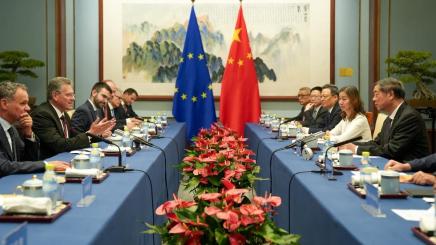
Europe’s economic relationship with China is entering a more confrontational phase. In October 2026, negotiations with Beijing produced tangible results: China agreed to moderate hybrid-vehicle exports to Europe, improve market access for several European products and provide greater predictability on rare-earth export licences. But these concessions address only part of a much broader imbalance. The EU is simultaneously preparing greater use of safeguards and other trade instruments across additional sectors, while France and Germany have called for a new rapid-response mechanism against severe economic pressure. As Europe becomes more willing to defend its economic interests, it must also be prepared for the possibility that China responds not through negotiation, but through economic coercion.
The EU already has an instrument designed to respond to such pressure. The Anti-Coercion Instrument (ACI) combines a broad range of possible countermeasures with a deliberately gradual process of examination, engagement and, only where necessary, retaliation. This makes it capable of addressing different forms and degrees of serious economic coercion, from targeted pressure on individual Member States or sectors to acute confrontations requiring a rapid and forceful response. Its potential should therefore neither be exaggerated through the familiar “trade bazooka” rhetoric nor underestimated as too cumbersome or limited to matter. With targeted adaptation, the ACI could also provide much of the rapid-response function that France and Germany now appear to be seeking in a new instrument.
What limits the ACI is therefore less the range of measures it can deploy than the way its procedures are organised. The Commission retains broad discretion over whether to open an examination, while a formal determination of economic coercion subsequently requires a qualified majority in the Council – even though neither step imposes economic costs on the third country. This allows political concerns about eventual retaliation to enter the process before retaliation is actually on the table, a particular problem when coercion concentrates costs on only a few Member States or sectors. A newly compiled GTPO dataset of 27 publicly documented episodes of economic coercion against EU Member States since 2016 illustrates this problem. In none of these cases did the Member States directly targeted or particularly exposed constitute the qualified majority required for an ACI determination. Even the broadest case involved only seven Member States, against the 15 needed, while 12 of the EU’s 27 Member States do not appear in the dataset at all.
The paper therefore proposes a targeted reform of the ACI. The instrument should first be normalised as a specialised response to economic coercion. Where the relevant Article 2 factors lend themselves to quantitative assessment, its early stages should move towards a more data-driven and semi-automatic model akin to EU trade defence, with published indicators triggering an obligation to examine potentially coercive conduct rather than leaving initiation entirely to political discretion. The formal determination of coercion should move from the Council to the Commission, while political control should increase as the process approaches the imposition of actual economic costs. Greater European solidarity should help cushion the disproportionate costs borne by targeted Member States or sectors, and the procedure should be streamlined so that it can move considerably faster in genuinely urgent cases.
These lessons extend beyond the ACI. As economic security becomes a more central part of EU policy, Europe will need institutions that can act collectively even when the costs of external pressure are distributed unevenly across Member States. An effective European response to economic coercion therefore requires more than an expanding arsenal of instruments. Early procedural steps should be predictable and capable of moving without repeated political bargaining, while political discretion should increase as decisions approach the imposition of real economic costs. The same logic is relevant to the solidarity mechanism currently being prepared by the Commission. The experience of the ACI suggests that solidarity should be built into Europe’s response to economic pressure from the outset, so that highly concentrated costs do not undermine the capacity for collective action.
Please find the full study by Lukas Schaupp here, including all references and sources.