| Grassroots initiatives representing marginalized groups within Russia are fighting the imperialist and patriarchal practices that sustain the current system of power. They are doing so by addressing the everyday problems of Russian citizens. |
| Increasing collaboration between the Russian liberal opposition in exile and such grassroots anti-war initiatives promises to add depth to debates about what Russia is and should be – debates that are no longer possible within the country. |
| The funding and cooperation formats of European partners should encourage the inclusion of voices that represent different constituencies and networks inside the country that can contribute to a multilayered understanding of Russia in times of increasing isolation. |
Below you will find the online version of this text. Please download the PDF version to access all citations.
Since Russia’s full-scale invasion of Ukraine, many Russians who oppose the war, actively work against it, or are threatened by the state’s ever-mounting repression have left the country. They have come to form a diverse anti-war community in exile that continues to engage in anti-war activism, often building on their remaining networks inside Russia. Whether justified or not, these actors have been described as potential “agents of change” when a “window of opportunity” opens for political transition in Russia. Yet it is currently unclear whether such a window will ever open and, if so, what form it may take.
Nevertheless, addressing the question of future change in Russia and to what extent the anti-war community in exile can contribute to it is fundamental – also for European partners. As Russia’s external aggression will not end unless the system of violence and oppression that sustains the current regime is broken, change is the necessary precondition for sustainable peace in Europe. Therefore, any mid- to long-term approach to Russia needs to address the question of how Russia can change.
This DGAP Analysis argues that the work of Russian activists fighting the structures of violence and oppression inside the country can be instrumental for debates about change in Russia in three ways:
- In exposing the imperialist and patriarchal system of violence that sustains not only internal repression but also Russian aggression against Ukraine
- In shedding light on the agency of the individual
- In formulating new visions for the country
Consequently, decolonial, feminist, queer, and other initiatives that address violence and oppression at the societal level can significantly enrich debates about change in Russia. Yet, these marginalized perspectives are not only muted entirely from public discourse in the country, but they also remain underrepresented at gatherings of the anti-war community in exile. Listening to these voices is especially worthwhile, however, as they can contribute to a pluralist debate about what Russia is and should be – a debate that is no longer possible inside the country.
The Anti-war Community in Exile
Following Russia’s full-scale invasion of Ukraine in February 2022, hundreds of thousands of Russians left the country. Most chose neighboring post-Soviet countries, Turkey, or Serbia for their emigration. Others went to the European Union – so many, in fact, that they outnumbered previous waves of Russian emigration to Europe.
A large share of early emigrees were young, educated, and liberal-minded, among them journalists, activists, defenders of human rights, and others who oppose the war and regime of President Vladimir Putin. Unable to continue their activities inside the country amid mounting repression, some of them engaged in political activism against the war and regime from exile. Early analyses estimated that, among those who left, 10,000 to 15,000 were politically active emigrees and their families. Due to continuing disengagement, this number is likely to be smaller today. Nevertheless, a highly diverse anti-war community has formed in Europe since 2022. It includes independent media; anti-war, human rights, and educational initiatives; political and civil society networks; artists; and support structures for Russian emigrees or those seeking to leave.
The Liberal Opposition
Prominent focal points of the Russian anti-war community have emerged around key figures who are rooted in Russia’s liberal opposition, which was largely forced into exile. Among them is Mikhail Khodorkovsky, an oligarch who amassed considerable wealth in the 1990s as head of the Yukos oil company. In 2003, he was arrested and, in 2005, convicted of various economic crimes and sentenced to jail. Due to Khodorkovsky’s open political engagement, his trial was widely regarded as politically motivated. After being pardoned in 2013, he left Russia and became a prominent critic of Vladimir Putin from exile. Shortly after Russia’s full-scale invasion of Ukraine, he was instrumental in establishing the Russian Anti-War Committee. Uniting prominent exiled figures, the Committee seeks to articulate a firm anti-war stance among Russian and Western audiences. The Committee’s regular conferences feature a broader range of exiled Russian anti-war initiatives. Khodorkovsky, who has built the most extensive ties to Western political institutions within the exiled community, also supported the establishment of a wider ecosystem of initiatives targeting Russian emigrees and strongly advocates for their interests. A prominent example is the Ark (Kovcheg), a transnational support network of hubs for Russians who have left or want to leave the country.
Another focal point within the Russian anti-war community in exile is the Anti-Corruption Foundation (FBK) founded in 2011 by opposition leader Alexey Navalny. In 2021, when Russian authorities designated FBK as “extremist,” it established its headquarters in Lithuania. After Navalny was killed in a penal colony in Western Siberia in 2024, his wife, Yulia Navalnaya, took over leadership of the organization. Today, FBK continues to engage in anti-corruption investigations of Putin’s circles. Its political activism is not focused primarily on Russians in exile but directed mainly at audiences inside the country. FBK regularly hosts the Yulia Navalnaya Forum, inviting Russian oppositional figures and experts to discuss policies for “the beautiful Russia of the future,” a vision for the country after Putin’s regime.
Free Russia Foundation, based in the United States, is another actor that unites prominent opposition figures like Natalia Arno, Vladimir Kara-Murza, and Russia’s former deputy energy minister Vladimir Milov. It publishes its own analyses and has become an important intermediary for the distribution of grants. It also provides support to the anti-war community, for example through its Reforum Spaces, which are networking and co-working hubs in various European countries. Given that any dissent is suppressed in today’s Russia, these formats and organizations are among the few platforms that remain for political debate and dispute on Russian politics.
The Russian liberal elite largely dominates political debates in exile. This liberal elite’s politization was significantly shaped by eschatological interpretations of what occurred in Russia during the 1990s and early 2000s – seeing those events through an end-of-history lens. Many of its representatives started their political careers during Russia’s early post-independent rapprochement with the West. This was a time that, despite severe economic, social and political hardships, nurtured hopes for liberalization and a democratic future. While Putin drifted off into the abyss of chauvinism and autocracy, many of his political opponents held onto the idea of turning Russia into “a normal country.” Andrei Kozyrev, who served as Russia’s first foreign minister from 1990 to 1996, insisted in 1992 that his country “will not cease to be a great power. But it will be a normal great power.”
Some of these – often well-known – representatives of the liberal elite, like Mikhail Khodorkovsky and Garry Kasparov, already left the country in the early 2010s. Others continued to be politically active in Russia before their opposition to the regime forced them into exile. These include Vladimir Milov (2021) as well as Gennady Gudkov (2019) and his son Dmitry (2021). Vladimir Kara-Murza and Ilya Yashin had remained in Russia when they were sentenced to long prison terms over their public denouncements of the war. Freed in a high-profile prisoner swap in 2024, both now continue their vocal criticism of the regime from exile.
Although the liberal opposition in exile forms a distinct and prominent group among the anti-war community, none of its representatives has taken the role of an unequivocal political leader. Further, support among the exiled community remains fragmented. However – irrespective of their different approaches, opinions, and audiences inside and outside Russia – the members of the liberal elite agree on their opposition to the Russian regime and commit their work to its demise.
Grassroots Initiatives
In addition to these prominent figures of the liberal opposition, the Russian anti-war community in exile consists of many grassroots initiatives run by activists who left the country following Russia’s full-scale invasion of Ukraine. These activists often link their opposition to the war to their fight against the oppressive structures of the regime inside the country.
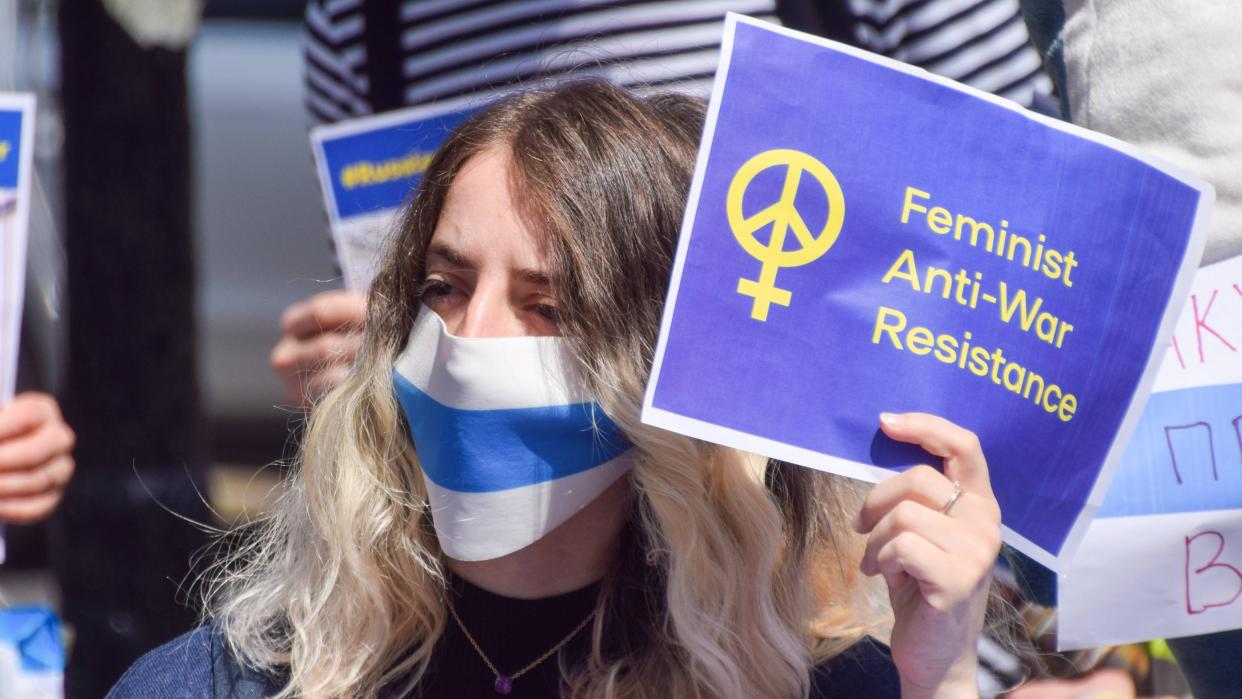
Feminist initiatives like the Feminist Anti-War Resistance take up the fight against domestic violence and the restriction of reproductive rights. LGBTQ+ groups like EQUAL PostOst advocate their cause outside the country and evacuate those inside of it who are at the highest risk. Decolonial groups like Asians of Russia highlight the diversity of the Russian Federation and point to the ongoing centuries-long exploitation of the periphery by the center. In 2022, dozens of such groups formed the Platform of Civic, Anti-War, and Humanitarian Initiatives (Platforma) to coordinate their collaboration. It is currently comprised of 80 organizations that operate across 25 countries – and partly from inside Russia – in the areas of human rights, education, culture, and research as well as on decolonial, humanitarian, feminist, and LGBTQ+ issues.
The diversity of this anti-war community is a reminder of the ethnic, cultural, and sociopolitical diversity in Russia
Many of these activists represent the “other Russia” beyond the elites in the big cities. Their horizontal networks often reach far into the regions of the Russian Federation, and many of them speak for the marginalized voices that are muted from the national discourse through near-total repression. Many – but not all – of those activists are younger Russians who can barely remember a time before Putin. Their political consciousness has been shaped by increasing repression and shrinking freedoms, symptoms of the illiberal turn taken by Putin that is often associated with the start of his third presidential term in 2012. At the same time, globalization and digitalization have exposed this generation to more Western culture and languages, potentially making it more amenable to looking beyond Russia’s borders.
The Subversive Potential of the Oppressed
Why should perspectives that are largely marginalized within Russia matter for debates about its future? The potential of decolonial, queer, feminist, and other grassroots activists lies in their shared emphasis on the need for societal transformation within Russia as a precondition for sustainable peace and, in the long run, for a democratic future of the country.
The Russian anti-war community widely shares the view that Russia’s external aggression is inextricably linked to internal repression. Russia’s aggression against Ukraine is facilitated by a domestic system of violence that sanctions any dissent and non-conformity. Through its years of dismantling independent civil society, repressing independent thought, and atomizing the population at large, the regime has essentially eradicated resistance to its policies. External and internal violence are two sides of the same coin – both driven forward by Putin’s regime and mutually reinforcing.
The imperial character of Russia’s assault against Ukraine has not only revived traumas of subjugation among Russia’s other neighbors. Imperial practices have also shaped relations between the center and periphery inside the country, including the exploitation of its regions and the suppression of the identities and languages of ethnic minorities and indigenous peoples. Furthermore, the curtailment of political freedoms in Russia has targeted and further marginalized other vulnerable groups, including journalists, human rights activists, and queer people. Women have become practically absent in politics, their rights continuously restricted in the name of “traditional values.” Through its nationalistic and chauvinistic propaganda, the regime has nurtured imperialist and patriarchal practices for many years. These practices not only laid the groundwork for Russia’s aggression against Ukraine but also excluded a majority of the Russian population from the country’s political life.
Decolonial, feminist, queer, and other anti-war initiatives fighting for those oppressed inside the country shed light on the societal dimension of this violence – that over the course of many years of repression and propaganda has become systemic. They raise questions of societal transformation, imperial legacies, and the ideological foundations of the war. They share the opposition to the Putin regime, but they object to the assumption that getting rid of it will be enough.
Regime Change is Not Enough
Pointing out and fighting the imperialist and patriarchal practices and discourses that sustain the current system of power in Russia is not an easy approach. It means asking uncomfortable questions related to societal responsibility, calling upon everyone to reflect their role in the ongoing aggression – both against Ukraine and inside the country. Yet, focusing on societal transformation is also empowering because it centers individual agency, which the Russian regime works hard to suppress. Doing so looks at people as subjects instead of mere victims.
To expose the power structures sustaining this violence, activists focus on hardships in everyday life. They address ecological problems in Russia’s regions that are related to resource extraction, assist in the evasion of military drafts, or create support networks for victims of domestic violence. They call out the disproportionally high share of soldiers from regions with ethnic minorities and indigenous peoples or offer legal advice, linking topics like (the lack of) freedom and lawlessness to violence and the war.
The diversity of this anti-war community is a reminder of the ethnic, cultural, and sociopolitical diversity in Russia – and the many perspectives that are muted inside the country. Their subversive potential does not lie in the popularity of their agendas among the Russian population. Public opinion polls largely mirror the regime’s antiliberal policies and propaganda. Yet, shedding light on exactly this societal dimension can contribute to the long-term goal of breaking the domestic cycle of violence without which Russia’s aggression against Ukraine cannot be explained. To that end, it is instructive to listen to the marginalized voices that have experience in fighting the constraining structures of oppression. Some of the issues they raise – like domestic violence or center-periphery relations – could also mobilize broader strata of society in the long term. Most importantly, their subversive potential lies in sharing experiences that would otherwise not be heard. By doing so, they show that there are various other perspectives, revealing the contingency of today’s Russia and allowing for an open discussion of what the country actually is and should be.
Underrepresentation Is a Limiting Factor
The subversive potential of the “other” Russia has also been recognized by the Russian regime, which sought to suppress it early on. The legal and societal marginalization of minorities and increasing nationalism that accompanied Russia’s evolution toward authoritarianism rallied Russians behind an identity the regime defines in opposition to the West. Queer, feminist, decolonial, and other dissident voices of the “other” Russia constitute a danger to the regime because they challenge the image of Russia it portrays.
In 2023, the Supreme Court of the Russian Federation issued a ruling that designated a non-existent “international LGBT movement” as an extremist organization, factually banning any advocacy and threatening anyone even vaguely associated with LGBTQ+ issues with criminal prosecution. Then, in 2024, that court designated as extremist an equally non-existent “Anti-Russian Separatist Movement” allegedly consisting of 55 seemingly unrelated regional organizations, including Asians of Russia or Free Buryatia Foundation. Factually, the ruling criminalizes any decolonial and ethnic anti-war initiatives. In the same year, the Feminist Anti-War Resistance was designated an “undesirable organization.” This July, Platforma became “undesirable” as well.
This criminalization also challenges anti-war initiatives in exile by isolating activists from their networks inside Russia and increasing transnational repression. Activists must fear prosecution of family members back in Russia, the loss of assets, and the impossibility of returning. The practical difficulties of relocation – and, in particular, the lack of funding exacerbated after the United States stopped its support through USAID – adds to the pressure.
It is in the interest of European countries to maintain a broad circle of Russian democratic partners
However, the initiatives of young activists within the Russian anti-war community are not only short on money. In comparison to the well-connected figures of the liberal opposition, they also lack human capital in the form of political or donor networks to Western institutions, as well as the necessary experience and language to navigate them. Among exiled liberal opposition figures, the causes of marginalized groups are often not deemed a priority or are met with outright skepticism. Many of these initiatives are organized horizontally without central leaders, which is another reason why voices from decolonial, feminist, queer, or other grassroots movements remain underrepresented in the debates of the Russian anti-war community in exile. This dynamic has been apparent for years. In 2023, during the first Brussels Dialogue, a conference jointly organized by members of the European Parliament and the Russian anti-war community, women attending the plenary session literally stood up to protest the lack of diversity on the panels. The underrepresentation of younger – including regional, feminist, or queer – activists is still being lamented today as limiting the discussions on the future of Russia.
There are signs, however, that this is slowly changing. A promising example is the significant role of ethnic minorities and indigenous peoples in the Platform for Dialogue with Russian Democratic Forces at the Council of Europe’s Parliamentary Assembly (PACE). This platform was established earlier this year to strengthen cooperation with Russian human rights defenders, democratic forces, free media, and independent civil society after Russia had been expelled from the Council of Europe in reaction to its full-scale invasion of Ukraine in 2022. At the initiative of Ukraine and building on the assumption that “genuine democracy in Russia is impossible without decolonization,” one third of the Platform’s 15 seats have been assigned to indigenous peoples and national minorities of the Russian Federation. Other examples of the increasing visibility of marginalized perspectives are the inclusion of diverse voices at events of the Anti-War Committee and in the framework of Peaceful Russia, a political party that was recently founded by anti-war politicians and activists in exile on the initiative of Ilya Yashin. The annual Congress of Anti-War Initiatives, supported by the European Union and German Federal Foreign Office, is another platform for discussing Russia’s external and internal aggression from a wide range of perspectives.
Recommendations
Russia’s external aggression will remain a threat to European security unless the system of violence facilitating it is broken. To induce such change, the work of Russian anti-war activists who actively fight this system can be instrumental in disclosing the imperialist and patriarchal structures that sustain it. Their focus on societal transformation and individual agency challenges the suppressive structures that sanction dissent and difference. Moreover, they bring a diverse set of perspectives to the table, many of which are among the most suppressed in Russian society today. These perspectives open and expand discussions about what Russia is and should be.
Combining these diverse perspectives with the outreach and networks of established liberal opposition figures and their inclusion in established discussion formats promises valuable synergies. They can add depth to debates about Russia’s future, particularly on unresolved – and sensitive – questions beyond opposition to the Putin regime, including on imperial legacies and center-periphery relations, on freedom and democracy, and on individual agency and responsibility.
Such long-term societal transformation can only succeed if it is driven by Russians. However, because Russian democratic actors are experiencing severe repression, they need support from Western partners. Amid the funding crisis, smaller initiatives are the first to collapse. Therefore, funding and cooperation formats should be continued to encourage the inclusion of voices that represent different constituencies in Russia – including women, ethnic minorities, and indigenous peoples as well as representatives of the queer community. It is in the interest of European countries to maintain a broad circle of Russian democratic partners with different perspectives and networks inside the country. Exiled initiatives can serve as intermediaries for support and knowledge transfer, contributing to a multilayered understanding of Russia at a time when the country is increasingly isolated. The minimum goal should be to sustain these grassroots initiatives because they can be instrumental when the time comes to rebuild pluralism and democratic debate in Russia.