
| Localized production by Korean defense firms in Germany could ease bottlenecks and create synergies. Air defense and multi-tier tech areas such as AI or synthetic aperture radar (SAR) are especially promising. |
| In addition to joint investments in AI research and adoption, Berlin and Seoul could form a technology alliance on physical AI sovereignty, including energy efficiency, world models, and hardware supply chain resilience. |
| Germany and the Republic of Korea (ROK) should expand their cooperation on nuclear non-proliferation, utilizing bilateral channels and linking expert agencies to make risk reduction and verification regular items on the Korea-EU agenda. Both countries should also collaborate to safeguard the Treaty of Non-Proliferation on Nuclear Weapons (NPT). |
Die Online-Version dieses Textes enthält keine Fußnoten. Um diese zu lesen, laden Sie bitte die PDF-Version herunter.
Introduction
Driven by shifting centers of relative power, technological advancement, and a unilateral change in the United States’ approach to global leadership, the world’s old order is breaking down. With a new order still taking shape, countries find themselves in a transitional period. At the World Economic Forum in Davos, Canadian Prime Minister Carney talked about a “rupture in the world order,” while German Chancellor Merz went even further, stating that the “international order, which was based on rights and rules […] no longer exists.” Similarly, Korean President Lee described the international order as “passing through a tunnel of severe chaos.” While these statements paint a dark picture, they also point towards a chance. As the post-Cold War global order is being remade, middle powers have a chance to step in and work towards creating new global stability at the end of the transition tunnel. As two countries that depend heavily on manufacturing and exports, and as hubs in their respective regional value chains, Berlin and Seoul should be ready to take the lead.
Arguably, the current shifts are most acutely destabilizing for countries which are closely connected to the US-led order. Germany and the Republic of Korea (ROK) are such countries. Both were rebuilt under American security guarantees and integrated into an open trading system supported by American market access. They are embedded in US technological ecosystems, with US hyperscale companies providing over 70 percent of their cloud and AI services.
Both Berlin and Seoul are confronted with profound changes in the security and economic arrangements that shaped their past half century. In May 2026, the Pentagon ordered a drawdown of up to 5,000 troops from Germany linked to Chancellor Merz’s criticism of US strikes on Iran. Seoul, for its part, secured relief from a 25 percent tariff only by committing to a high tech and shipbuilding investment package worth hundreds of billions of USD. Concrete projects are currently being worked out, including investing $22.3 billion in building a gas power plant in Texas and $120 billion in building eight nuclear power plants in the United States. In addition, both sides are considering an LNG pipeline project in Alaska for $54 billion.
For Seoul as well as Berlin, this transformation of the US posture creates an incentive to diversify their partnerships. But they should also use it as an opportunity to become order-creating powers. Germany, as the globe’s third largest economy, should play a pivotal role in a world increasingly shaped by middle power leadership. Though the ROK is smaller, it has the economic and military resources of a top-tier middle power and robust economic growth. Both countries also share the history (and, in the case of Korea, the present) of division. Furthermore, both are keen to diversify without abandoning or undermining their alliance with the United States, likely making their approaches compatible. Indeed, a “Korea–NATO Defense Industry Partnership 2.0” was announced in July, and at a meeting in late October, President Lee and Chancellor Merz agreed to an enhanced strategic partnership spanning technology, defense, energy, and supply chains. Furthermore, Germany and the ROK have been part of recent initiatives at the G7 to address the Strait of Hormuz blockades.
Against this backdrop, this policy brief examines domains where bilateral cooperation could increase both Germany’s and the ROK’s resilience and help stabilize the international order at large. This paper identifies three fields in which there is substantial room for mutually beneficial cooperation: Regarding security, German cooperation with Korean defense firms in the form of localized arms production could resolve dependency by creating new industrial partnerships and synergies. With regard to technology, Germany and the ROK should replicate the recently established UK-Germany Innovation Corridor and create a Germany-Korea Sovereign Technology Alliance. On nuclear issues, German-Korean bilateral cooperation should assume a clearer role regarding the Treaty of Non-Proliferation on Nuclear Weapons (NPT) and utilize existing bilateral channels and link expert agencies to make risk reduction and verification regular items on the Korea-EU agenda.
Security Cooperation
Between 2021 and 2025, Germany and the ROK accounted for 5.7 percent and 3 percent of global defense exports, respectively. Although Germany’s and Korea’s numbers look modest compared to those of the United States (42 percent), Germany’s exports grew by 15 percent during that time, while the ROK’s increased by 24 percent. Roughly 80 percent of Germany’s defense demands are met by domestic or European suppliers even though the country is heavily dependent on US supply in aviation and air defense. With Germany’s restrictions on public debt having been eased, its defense budget and demand for defense goods are on the rise. As a result, there is a lot of potential for the ROK and Germany to intensify their cooperation.
The foundation is there: Germany and the ROK can look back at a wealth of defense cooperation projects and close links between industries. Between 2004 and 2024, the ROK regularly ranked among the top ten export markets for German military equipment. Looking at the average over the past 20 years, the ROK was Germany’s seventh most important market for defense goods, including parts for submarines and combat ships, parts for tanks and armored vehicles, and electronic communications equipment.
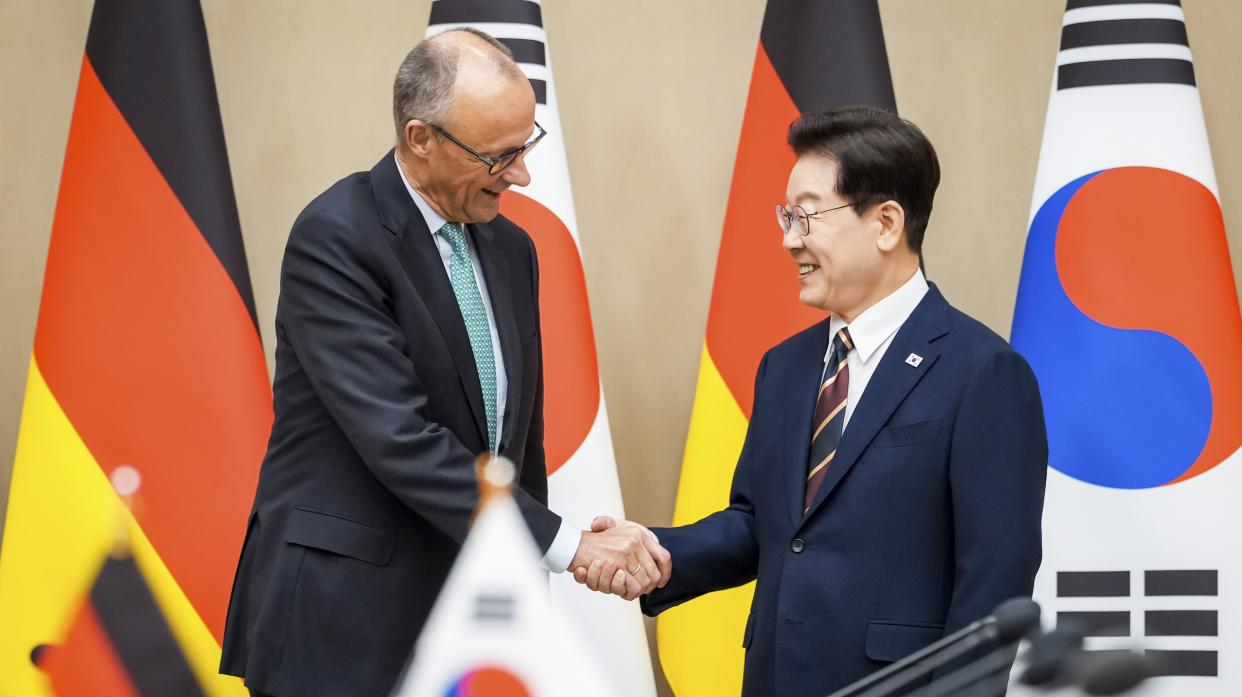
Chancellor Friedrich Merz visited the ROK on October 29, 2026, to participate in the 19th Asia Pacific Conference of German Business. With South Korean President Lee Jae Myung, Merz agreed to upgrade the bilateral relationship Germany and the ROK to an “Enhanced Strategic Partnership.” In their joint statement, the two leaders pledged to intensify cooperation in the field of security and defense:
“Both sides are committed to deepening their relations in the area of security and defence by pursuing regular military exchanges, training cooperation and strengthening information exchanges. [...] As partners with strong respective defence industrial capacities, both sides encourage their defence industries to explore mutually beneficial areas for further cooperation.”
This agreement builds on an important step taken in 2023, when Germany announced that it would treat the ROK as a “NATO-equivalent country.” This makes it possible for Korean companies to procure non-sensitive defense and dual-use materials from their German counterparts directly, without going through the Berlin government’s normal export approval process.
In the meantime, the EU and the ROK have also begun negotiations on a bilateral pact on information security. In addition, there are two more areas in which they could further advance cooperation:
1. Air Defense.
While Germany currently possesses a world-class short-range air defense system and uses Patriot systems for long-range purposes, it needs to develop an efficient medium-range air defense system, and the ROK has capabilities. Its LIG Defense & Aerospace established a European office in June 2026 to launch a venture with Rheinmetall to co-develop 20-kilometer-range interceptor missiles for the short-range Skynex architecture. Hanwha has also opened a new subsidiary in Berlin in April 2026, “designed to position Germany as its central European hub for defense activities, industrial cooperation and capability delivery.” Given both companies’ local presence, the ROK and Germany could expand this type of collaboration in the future to a mid-range air defense framework, diversifying Germany’s portfolio and creating synergies between the two countries’ industries.
2. Dual goods.
The ROK could also provide the Bundeswehr with multi-tier dual use goods in areas such as AI, synthetic aperture radar (SAR) tech, and unmanned ground vehicle (UGV) components without encountering the regulatory delays associated with importing US tech components.
AI Cooperation
Both Germany and the ROK rely heavily on AI products from the United States and China. Washington is already restricting exports of the most advanced technology on national security grounds. While China has reportedly discussed similar measures, it aims at dominance in AI, as it did with batteries and solar energy products.
Regarding AI, Germany and the ROK have complementary strengths, and industrial alliances between German and Korean companies are increasingly common, including cooperations between Hyundai HD and Siemens, LG and SAP, and Korean Rainbow Robotics and Schaeffler.
The ROK is the world leader in manufacturing memory chips and has rising start-ups such as Furiosa AI that aim to compete with companies like NVIDIA. The Seoul government is attempting to retain control over strategic assets within the country by building its own data centers and mobilizing resources through its national growth fund. Germany, for its part, possesses one of the world’s fastest-growing defense tech clusters, whose AI systems are tested on the battlefield in Ukraine. In addition, Germany has large-scale industrial manufacturing and a thriving robotics industry.
To advance cooperation, four avenues are suggested:
1. Korean-German Technology Innovation Corridor.
Seoul and Berlin should replicate the recently established UK-Germany Technology Innovation Corridor, which is spearheaded by the UK consulate in Frankfurt. The Corridor is based on a bilateral economic agreement linking the tech ecosystems of both countries. It focuses primarily on deep tech and aims to accelerate the adoption of cutting-edge technologies in major manufacturing companies. Such an initiative could give German companies – which so far rely solely on US chips – access to advanced AI inference chips from companies like Furiosa AI, thereby diversifying their sources. Furthermore, the Innovation Corridor could help accelerate the rollout of defense tech start-ups such as that of ARX Robotics in Korea. A starting point could be for Seoul and Berlin to dedicate about EUR 20 million to joint physical AI research. This is the same amount as Germany and the UK have put up for joint quantum research as part of their Technology and Innovation Corridor.
Agencies in charge: Korea (Berlin Embassy) and Germany (Federal Ministry for Digital Transformation and Government Modernization).
2. Korea-Germany Sovereign Technology Alliance.
A Korea-Germany alliance could be modelled after the recently announced Canada-Germany Sovereign Technology Alliance. It could focus on physical AI sovereignty, including energy efficiency, world models, foundation models for robots, vision-action models, hardware supply chain resilience, and the scaling of robotics production in both countries.
Partners: Germany (Robotics Germany, which unites major institutions and could facilitate the formation of consortia) and Korea (the Korea AI & Software Industry Association).
3. AI security.
Berlin and Seoul could develop a framework for reducing reliance on Chinese open-weight models in line with their recent joint declaration. It would require businesses to have a contingency plan in case they lose access to models from non-trustworthy suppliers. The two countries would jointly commission research assessing how much it would cost businesses to switch to non-Chinese models if China were to take punitive measures.
Agencies in charge: Korean and German AI safety and security institutes.
4. Physical AI benchmarking.
Seoul and Berlin should establish a common framework to assess the advances of (humanoid) robots, covering their progress in terms of tactile, sensory, and reasoning capabilities. Existing tests for benchmarking humanoid robots developed by a research group around Werner Kraus at Fraunhofer IPA should be included, scaled, and industrialized. Both countries being physical AI powerhouses, such a joint framework could further strengthen industries in both countries.
Agencies in charge: Germany’s Federal Motor Transport Authority and the Korea Transportation Safety Authority, which already assess the autonomous capabilities of cars. The two agencies could become world leaders in evaluating (humanoid) robots.
Nuclear Cooperation
Germany and the ROK have more room for nuclear cooperation than their different security situations might suggest. Evidently, the ROK is directly exposed to the DPRK’s nuclear and missile threats and relies on extended deterrence centered on its alliance with the United States, whereas Germany participates in NATO’s nuclear deterrence framework and has experience in arms control and verification in Europe. The greatest potential for cooperation lies in nuclear risk reduction and verification, where both countries can bring their experience to the table, with relevant agencies cooperating directly.
The foundation is already there: Official disarmament and non-proliferation dialogues have been documented since at least 2019, and in 2020, the two governments agreed to hold them regularly. At the 2026 NPT Review Conference, Germany and the ROK were co-sponsors of the working paper “Reducing the Risk of Nuclear Conflict,” which proposes measures for crisis communication, transparency, and confidence-building. Berlin and Seoul also collaborated on a separate joint working paper on the DPRK nuclear issue.
Information channels regarding nuclear issues have multiplied. In the 2024 ROK-EU Security and Defense Partnership, both sides committed to safeguarding the NPT and making disarmament a fixed and recurring agenda item. At the second Security and Defense Dialogue in May 2026, they consolidated the institutional foundation and agreed to convene a standalone round of consultations focused on non-proliferation and disarmament policy. Against this background, the bilateral channel between Germany and the ROK could be used to focus on narrower practical issues.
Future cooperation should concentrate on two areas:
1. Risk reduction and verification.
Seoul and Berlin should utilize existing bilateral channels to make risk-reduction and verification regular items on their cooperation agenda within the frameworks of disarmament/non-proliferation consultations and the Indo-Pacific Dialogue. Ensuring continuity should be a priority.
2. Practical cooperation and multilateral diplomacy.
In 2024, a German Open Skies observation aircraft visited the ROK at the invitation of the Korea Arms Verification Agency (KAVA). The Bundeswehr Verification Center (ZVBW) presented the aircraft and Germany’s verification experience, describing the ROK as a close partner in arms control. As Northeast Asia does not have the kind of arms control framework existing in Europe and as the ROK is not a party to the Open Skies Treaty, such exchanges are very valuable. The ZVBW and KAVA should establish a clear agenda for cooperation and organize follow-up expert visits, joint workshops, and training on specific verification issues, such as nuclear verification.
Furthermore, Germany and the ROK should share the results of their bilateral exchanges through multilateral channels. Both countries already support similar risk-reduction measures within the NPT. The fact that the 2026 NPT Review Conference concluded without agreement on substantive outcomes underscores the need for an approach in which countries with shared interests work on specific issues. This form of limited yet substantive leadership is possible for Germany and the ROK: It involves two countries addressing issues on which they already share some degree of consensus, gaining practical experience, and sharing it with other nations.
Korean-German nuclear cooperation already has the necessary points of contact and institutions. The key now is to link these elements through regular working-level cooperation.
Conclusion
Chancellor Merz has officially invited President Lee to visit Germany next year. This should be seen as an opportunity to institutionalize the newly established enhanced strategic partnership. At the same time, both governments should also finalize their Agreement on the Protection of Classified Military Information and draw up a list of concrete cooperative projects in defense. As Lee and Merz affirmed in their joint statement after their last meeting on October 29, 2026, Germany and the ROK “share a deep commitment to universal human rights, a rules-based international order, free trade, ambitious climate action…[and] remain steadfast in their resolve to protect and strengthen the multilateral system.” The multilateral system needs Seoul and Berlin to continue to demonstrate this deep commitment through collaborative action and global leadership.
This paper argues for closer cooperation in three areas: In defense, localized Korean production in Germany would give Berlin an alternative to US suppliers and the ROK a like-minded and long-term industrial partner in Europe. In technology and AI, a sovereign technology alliance, a “technology corridor,” and a joint AI security framework would reduce both countries’ reliance on US and Chinese AI and hardware. Regarding nuclear cooperation, regular exchanges between expert agencies on risk-reduction and verification would give both countries practical expertise on an issue on which the multilateral process has stalled. The key advantage of these areas of cooperation is to lessen dependence on Washington without abandoning US partnerships. By pursuing these avenues of cooperation successfully, Germany and the ROK can also showcase what middle-power leadership can look like in a transformed global order.