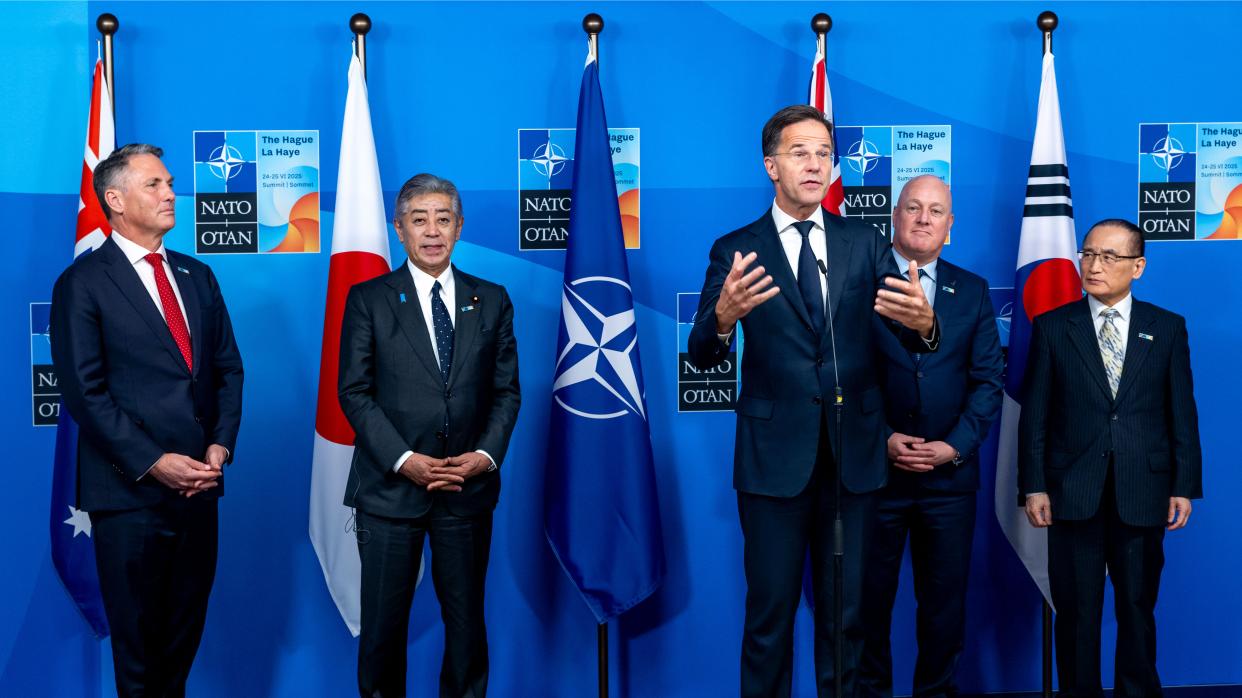

| Defense-industrial cooperation is particularly important: The most advanced collaboration in this area takes place between South Korea and Poland. The greatest potential lies in technology transfer and the establishment of local production facilities. |
| Through their maritime presence in the Indo-Pacific, European nations signal that they are closely monitoring China’s “gray-zone” activities. Many parallels can be drawn between China’s actions and Russia’s hybrid warfare. |
| Maritime situational awareness and (nuclear) risk reduction offer additional potential for deeper cooperation. European and Indo-Pacific states should work together to exert pressure on China in this area. |
Below you will find the online version of this text. Please download the PDF version to access all citations.
Uncertainty Regarding US Involvement
The profound changes in the security architecture of Europe and the Indo-Pacific create strong incentives for closer cooperation between states in both regions, as each side possesses information and capabilities that the other needs. Among the most important drivers of this development – in addition to the threats posed by Russia, China, and North Korea – is the strategic realignment of the United States. However, this realignment is open to varying interpretations. While the National Security Strategy released in November 2025 and the National Defense Strategy published earlier this year emphasize that the United States views China and its containment in the Indo-Pacific as a central strategic challenge, both documents no longer explicitly designate the Indo-Pacific as a region of priority for US strategic interests.
This fuels doubts in East Asia regarding the United States’ resolve to place the region under the protection of its extended deterrence. The summit between Trump and Xi in Beijing in May 2026 further intensified these concerns, as Trump refrained from publicly reaffirming US security guarantees for Taiwan during the meeting. Consequently, uncertainty is growing among US allies regarding Washington’s actual priorities and the reliability of Washington’s security commitments. Similar concerns are evident in Europe, particularly in light of US President Trump’s aggressively worded claim to Greenland and his repeated expressions of doubt regarding the purpose and value of NATO.
To make matters worse, China and Russia – which pose the greatest security threats and challenges from an Indo-Pacific and European perspective, respectively – are expanding their military cooperation. The armed forces of both countries are conducting more joint exercises and training, with Beijing benefiting from Russia’s frontline experience in Ukraine, particularly with regard to the use of drones and defense against them.
It is alarming that both countries are expanding their nuclear arsenals and threatening to use nuclear weapons: Russia, to hedge its war against Ukraine, and China, to signal its growing power projection. For the first time, China launched an intercontinental ballistic missile from a nuclear-powered submarine. Although this test did not violate any arms control agreements, it underscored China’s pursuit of a nuclear second-strike capability. Parallel to this event in the Indo-Pacific, Russia sent a warning signal to Ukraine and the West this past spring through a series of nuclear-related activities.
Against this backdrop, the question of how European and Indo-Pacific partners can contribute to stability, arms control, and risk reduction in both regions through closer cooperation is becoming increasingly urgent. To find answers to this question, this analysis first examines the areas in which Europe and the Indo-Pacific already collaborate. It then outlines opportunities for deepened cooperation and formulates recommendations, particularly for the German government.
Taking Stock: How EUROPEAN and Indo-Pacific Partners Are Already Strengthening Each Other
Arms Exports and Defense-Industrial Cooperation
Defense-industrial cooperation is the most concrete and advanced form of collaboration between Europe and the Indo-Pacific.
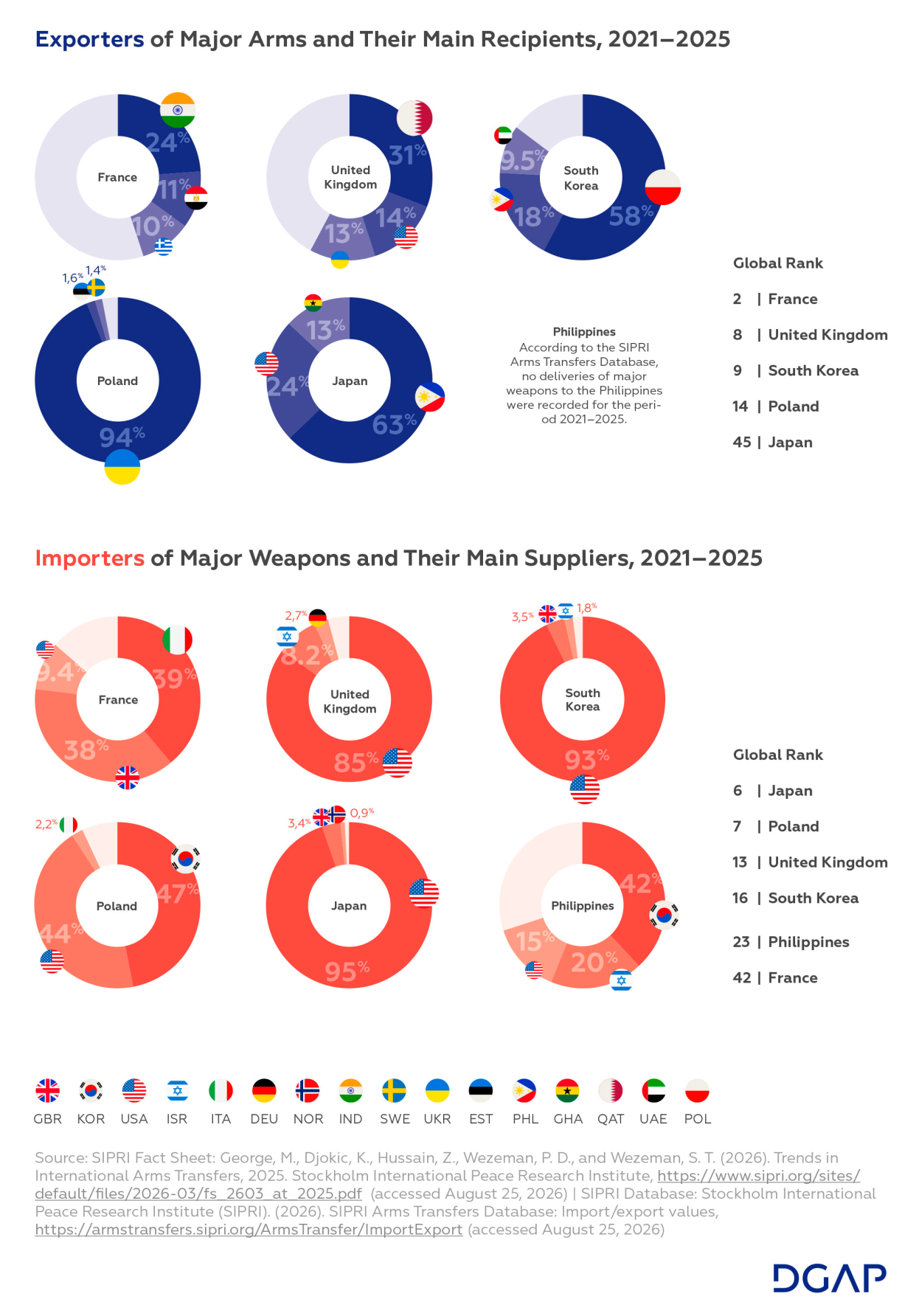
This is particularly evident in arms exports from South Korea to Europe, primarily to Poland. South Korea currently directs 40 percent of its global exports to Warsaw. Conversely, the level of dependency is even higher: 47 percent of all Polish arms imports between 2021 and 2025 originated in South Korea, closely followed by imports from the United States. Looking ahead, the greatest potential lies in greater localization within Poland itself, including not only maintenance and servicing but also repairs and co-production. Such a development could see Poland emerge as a hub for other European states, such as the Baltic countries and Romania that also procure South Korean military equipment. Beyond Poland, the South Korean defense company Hanwha Aerospace, for instance, plans to establish a manufacturing facility in eastern Germany.
Another prominent example of the increasingly close defense industry ties between the two regions is the GCAP program, in which the United Kingdom, Italy, and Japan are developing a sixth-generation fighter jet. This collaboration was made easier by Japan’s decision in April of this year to lift its export ban on lethal weapons. The GCAP program could gain further momentum now that Germany and France will no longer be developing the joint fighter jet originally envisaged in the FCAS program. On the one hand, the chairman of the Italian defense contractor Leonardo has said that German participation was conceivable; on the other hand, the German defense industry appears to be interested in such a move.
In addition to Poland and the United Kingdom, France also has close defense-industrial ties to the Indo-Pacific: The country has become the world’s second-largest arms supplier (after the United States), with approximately 35 percent of its exports now going to the Indo-Pacific region.
Cooperation of this kind can contribute to conventional stability insofar as countries in both regions are expanding their defense capabilities, thereby strengthening (regional) deterrence. At the same time, the intensification of defense-industrial cooperation sends a signal to China, Russia, and North Korea that an escalation in one region would also affect partner countries in the other region.
Defense-industrial cooperation can also prove significant for nuclear stability, as it fosters trust and establishes institutional channels between countries in both regions. First institutional approaches in this regard already exist. For instance, the NATO-IP4 framework could be utilized more systematically to exchange views on nuclear issues, including disarmament and non-proliferation. Furthermore, expanding defense-industrial cooperation strengthens the credibility of conventional deterrence in both regions, thereby reducing the pressure to consider developing independent nuclear options. Indirectly, such cooperation thus serves to curb nuclear proliferation.
The reason for that is that the threshold for the first use of nuclear weapons – especially against non-nuclear-weapon states – is extremely high. Given the political and normative costs involved, it is highly unlikely that a nuclear-armed state like China would consider such a move against countries like Japan or South Korea. The far more immediate threat to these states lies in the conventional domain. In this respect, a credible conventional deterrence posture raises the cost of such an attack, while the probability of a nuclear strike remains structurally low.
Maritime Presence in the Indo-Pacific: Europe’s Signal to China
The two regions have also grown closer as a result of European maritime presence and operations conducted as part of “Freedom of Navigation Operations” (FONOPs) in the Indo-Pacific. France is particularly engaged in this area and regularly conducts FONOPs in the South China Sea and the Taiwan Strait.
The United Kingdom, too, is active in the maritime domain: Since 2021, the Royal Navy has maintained a permanent presence in the region with the offshore patrol vessels (OPVs) HMS Spey and HMS Tamar, which are operated by rotating crews. This presence is complemented by the “European Carrier Group Interoperability Initiative,” which organizes the temporary deployment of European carrier strike groups to the Indo-Pacific.
These two forms of presence complement each other in terms of the political signals they send. OPVs enable a presence that is permanent but low in combat power – and therefore low-profile for maintaining maritime situational awareness and sanctions enforcement. In contrast, rotating carrier strike groups have a limited duration of presence but possess significant combat power and often generate considerable media attention. This type of deployment is particularly well-suited to demonstrating solidarity with partners in the region, as it is perceived as a decidedly political gesture. Both types of deployment have the potential to act as a deterrent against China, as the various forms of military presence can signal that Europe is viewing Beijing’s increasingly aggressive conduct towards its neighbors with concern.
Another argument in favor of closer cooperation is that countries in Europe and the Indo-Pacific are increasingly confronted with “grey zone” activities by their adversaries. Observers, for instance, frequently draw parallels between Chinese coast guard and naval activities in the South China Sea and Russian hybrid warfare in the North and Baltic Seas. European and Indo-Pacific nations should learn from one another, as similar capabilities are required in both theaters to counter, inter alia, acts of sabotage against critical infrastructure – for instance, when it comes to defending against the cutting of undersea cables or incursions into the airspace of NATO members or Taiwan. It is precisely these activities by China and Russia – which are conducted below the threshold of open confrontation – that must be uncovered and contained.
Regular FONOPs, combined with a permanent (albeit modest) maritime presence by European nations in the Indo-Pacific, make it more difficult to carry out such intimidation maneuvers. Furthermore, by establishing and expanding shared situational awareness and reconnaissance capabilities, hybrid threats can be identified at an early stage and attributed to an aggressor, which in itself has a deterrent effect. This approach helps strengthen conventional stability in both regions. As with defense-industrial cooperation, it is evident in this area, too, that the expansion of conventional capabilities can help curb nuclear proliferation dynamics.
Two Additional Areas of Work to Improve Security
Beyond the existing collaboration, there are two additional areas in which deepening European-Indo-Pacific cooperation could strengthen both conventional and nuclear stability and support risk reduction.
First, maritime situational awareness presents an opportunity for enhanced cooperation. This includes AI-driven pattern recognition, the analysis of satellite imagery, and data fusion. All of these capabilities are relevant in the North and Baltic Seas as well as in the South China Sea. The Philippines offers a concrete example: The country has a significant need for technologies related to maritime situational awareness, satellite access, and “over-the-horizon” capabilities – needs that can be met in part by European actors but also by regional partners such as Japan and South Korea.
For example, Europe could provide the Philippines with better access to satellites through the EU’s Copernicus Earth observation program (CopPhil). Via Copernicus, a civil satellite infrastructure has already been established in Manila. Similarly, the offerings of commercial providers such as Hensoldt UK could be expanded. As a supplier to the South Korean shipbuilder Hyundai Heavy Industries, Hensoldt UK equips patrol boats and corvettes designated for the Philippine Navy with navigation radars.
A second, more sensitive area for cooperation concerns issues of nuclear arms control. Formal agreements with China are considered virtually out of the question, as Beijing is unwilling to accept restrictions on the expansion of its nuclear arsenal. In any case, China does not look primarily to European or Indo-Pacific states with regard to these issues but to the United States, against which it measures itself. Nevertheless, countries in China’s “neighborhood” are affected by the expansion of its nuclear capabilities – as are European nations, although the effect there is more indirect: If the United States focuses more heavily on deterring China, it could scale back the nuclear umbrella it provides for Europe.
Risk reduction measures can be considered a more realistic starting point than formal arms control agreements. They could include China committing to binding, institutionalized notifications prior to missile launches and, for example, acceding to the Hague Code of Conduct against the Proliferation of Ballistic Missiles. Equally desirable are the establishment and expansion of crisis hotlines as well as an agreement on the protection of nuclear facilities in the event of war.
Against this backdrop, European and Indo-Pacific partner states should be persistent in pressuring China to adopt a more open stance on risk reduction. This effort can be complemented by the transfer of European arms control and verification expertise to partner states in the region. Examples of this include sharing surveillance technology and the associated know-how – such as that concerning aerial reconnaissance – derived from the Open Skies Treaty.
Next Steps: Six Recommendations for Germany and Its Partners
Based on the preceding sections, there are six recommendations that Germany and its partners should implement to contribute to conventional and nuclear stability as well as to arms control and risk reduction in both regions.
A step that can be implemented relatively easily in the short term, given existing partnerships, is to expand defense cooperation with South Korea – and, looking ahead, with Japan – to move beyond mere arms exports. The South Korean “model”, which involves not only exporting but also transferring technology with the goal of increasing (co-)production within partner countries, should serve as a blueprint for other areas of capability, particularly for drone and anti-drone technology. Indo-Pacific partners should use the ‘NATO Front Door for Industry’ portal, presented by NATO at this year’s summit, to gain a centralized overview of the Allies’ concrete needs. In this way, countries such as South Korea can contribute to the (rapid) rearmament of Germany and Europe.
Joint scenario exercises and increased information sharing with South Korea, Japan, and the Philippines to share insights into the deepening cooperation between China, North Korea, and Russia should also be considered. The goal is to be prepared for the growing security challenge posed by the collaboration between these countries. Drawing on the information and findings from such exercises, NATO should, in its deterrence and defense planning, give greater consideration to the technological and industrial support China provides to Russia – support that could extend beyond the war against Ukraine.
Germany should continue and expand its naval and air force operations in the Indo-Pacific in 2027 to signal to China that it is actively committed to security and stability beyond its own region. One conceivable example would be the deployment of a P-8 Poseidon aircraft to the Philippines for maritime surveillance – a long-range reconnaissance aircraft of the same type was already deployed to India earlier this year. Given China’s increasingly aggressive behavior in the South China Sea, this would be an appropriate step. However, nationally planned deployments should be coordinated and implemented to a much greater extent at the European level. In light of limited military resources, it is all the more important that countries such as Germany, France, and the UK not only coordinate their actions sequentially but also cooperate more closely on the ground through joint deployments and exercises with local partners.
With regard to Ukraine, another opportunity for transregional cooperation is emerging: The IP4 states are already actively supporting the country under attack through sanctions, financial aid, and the provision of non-lethal military equipment. This support could be expanded. Following a ceasefire, Japan and South Korea could contribute to a potential “reassurance force” in the area of cyber defense. Both countries possess recognized strengths in this area and already share some information about their capabilities with NATO, for instance, within the framework of the “NATO Security Assistance and Training for Ukraine Mission,” to which Japan has deployed personnel. Consequently, Germany, together with its European allies, should work towards the targeted integration of Indo-Pacific partners into specific, non-frontline functions. This would underscore the fact that Indo-Pacific partners can make very concrete and practical contributions to security and stability in the Euro-Atlantic region.
At an institutional and strategic level, it is necessary to establish and expand Indo-Pacific expertise within ministries and think tanks in Europe without focusing exclusively on China. Instead, understanding of like-minded partners, such as Japan, South Korea, and the Philippines, or of countries such as India, should be improved.
Regarding arms control and risk reduction, the priority for Europeans and their Indo-Pacific partners should be to put pressure on China to take part in low-threshold confidence-building measures, such as hotlines and advance notifications. Even if the prospects for success are not very high, there are levers that could be utilized. For instance, the EU’s FDI screening mechanism could be expanded to link approvals for Chinese investments to Beijing’s willingness to participate in confidence-building measures. The Bundeswehr Center for Verification Tasks (ZVBW) could also play a role in risk-reduction measures. While the ZVBW is ill-suited for operational tasks in the Indo-Pacific – due to the absence of an overarching (treaty-based) architecture comparable to the Vienna Document or the CFE Treaty in the past – sharing methodological expertise could add value to cooperation with Indo-Pacific states. This is already being practiced with South Korea.


