| Ukraine has become one of the main security actors shaping Eastern Europe. Its defense against Russia is propelling institutional adaptation within the EU |
| How the EU deals with Ukraine tests its geopolitical credibility and capacity to act. Its ability to anchor Ukraine has profound implications for the entire EU project. |
| Russia’s role in Eastern Europe has fundamentally changed. It is no longer an imperial hegemon leveraging economic and energy dependence. It is now a disruptive, spoiling power relying on hybrid warfare, election manipulation, and sabotage. |
| The post-Soviet “gray zone” has collapsed. While Ukraine and Moldova drive structural decoupling toward the EU, Belarus has been absorbed into Russia’s orbit. |
Below you will find the online version of this text. Please download the PDF version to access all citations.
- About the Changing Regional Orders Series
-
Due to its war against Ukraine, Russia has lost its role as regional hegemon in Eastern Europe, the South Caucasus, and Central Asia, as well as its impact in the Western Balkans. Moscow not only has to bargain with states in these regions for influence but also with other powers such as China, Türkiye, and Iran. Emerging regional powers and authoritarian governance are challenging the EU’s influence, creating insecurity, transactional relations, and the absence of any
functioning order.The DGAP series “Changing Regional Orders” examines how Russia’s war against Ukraine is shaping regional orders. It explores key regional trends and Russia’s changing interests. The series discusses how the EU should adapt to the changing dynamics and their impact on its enlargement and neighborhood policies
- Further Publications in this Series
-
The Decline of Russian Power in the Western Balkans
Fragmentation Amid Intensified Geopolitical Competition
Central Asia’s Shifting Regional Dynamics
Navigating the Impact of Russia’s War Against Ukraine


This DGAP Policy Brief examines the transformation of the regional order in Eastern Europe and how it is shaped by Ukraine and Moldova. Following their independence, both countries were perceived as contested geopolitical space on the EU’s periphery. While other Central and Eastern European states joined the EU during 2004’s “Big Bang Enlargement,” Ukraine, Moldova, and Belarus remained in the geopolitical buffer zone between Russia and the EU. The three countries were later grouped into the EU’s Eastern Partnership (EaP). In 2014, this dynamic shifted significantly when Association Agreements and Deep and Comprehensive Free Trade Areas (DCFTAs) were signed with Ukraine and Moldova. In 2022, their decoupling was further accelerated following Russia’s full-scale invasion.
This decoupling and subsequent reorientation of Ukraine and Moldova toward the EU has occurred in terms of security, energy, economy, and society. Belarus, while not a focus of this paper, is, on the contrary, pursuing closer integration with Russia – meaning the “in-between” space is disappearing. Russia’s war on Ukraine made it practically impossible to engage with both the EU and Russia in this region. Further, the debate around decolonization, Russian imperialism, and the reclamation of historical narrative has recently reemerged, especially in Ukraine where it has been consolidated since 2014. This is important because such identity consolidation provides the necessary domestic legitimacy for bearing the costs of the war.
Key Trends in the Region
To begin to understand how Ukraine and Moldova are transforming the regional order and the EU’s strategic response, we must first examine four related trends.
1. Ukraine Becomes a Security Actor in Eastern Europe
The initial objective of Russia’s war was to destroy Ukraine’s statehood. Yet that war has led to the collapse of the post-Soviet space with Russia as an imperial center. As Ukraine becomes a key security actor in the Black Sea and, increasingly, globally, it has driven this new regional order. Since Ukraine’s defense against Russia simultaneously defends EU borders, Russia is no longer the only actor to project hard power in the Eastern Neighborhood. While Ukraine remains a security receiver, it is now a military power in terms of drones and electronic warfare. It feeds data from the battlefield to around 800 drone manufacturers for constant innovation. Ukrainian defense companies are integrating with European defense companies.
The war has also led to a decrease in trust in Russia as a partner in the wider region. Following Ukraine’s trajectory, other states, including Armenia and countries across Central Asia, have actively sought to diversify their security, political, and economic relationships away from Moscow – trends that started earlier but were further accelerated by the war.
2. The Black Sea Emerges as a Geopolitical Hub and EU Space
In the context of the war, the Black Sea region has emerged as a crucial security arena. Beyond its military dimension, it serves as a vital artery for agricultural exports, energy transit, and critical infrastructure linking Europe to the South Caucasus and Central Asia via the Middle Corridor. Ukraine’s asymmetric military successes have degraded Russia’s Black Sea Fleet and exposed the vulnerability of occupied Crimea, where attacks continue from the Ukrainian side. Russia remains an active threat, particularly through increased drone attacks in the Black Sea and on Ukraine’s shipments and ports.
Simultaneously, the war has elevated the strategic importance of NATO members – particularly Türkiye and Romania – and the EU for maritime security, energy transit, trade, and infrastructure development. It has also pushed countries to work on defense and security cooperation despite disagreements related to norms and values. The regional order is now shaped by relations that have become more pragmatic and interest-based with a focus on security first.
To address the increased importance of the Black Sea, the European Commission adopted a new strategic approach to it in May 2025 that aims to position the EU as a key security and connectivity actor in the region. Driven primarily by Romania and the EU institutions, this initiative argues that the Black Sea is no longer peripheral but integral to broader European security, trade routes, and postwar reconstruction. However, EU member states lack a shared commitment to fund and drive this strategy. Governments in several capitals view it as competing with existing regional frameworks, particularly the EaP.
3. EU Enlargement Experiences Revival
In June 2022, the European Council granted EU candidate status to Ukraine and Moldova. This move was not only a direct response to Russian aggression, but it also marked the revival of enlargement policy. It transformed accession into a core geopolitical credibility test for the EU and linked it with security. This shift signals the EU’s transition from a primarily normative actor to a strategic one and tests its ability to be a geopolitical actor.
The accession of Ukraine and Moldova is coupled. The governments in both Kyiv and Chisinau aim to join the EU in the next few years while geopolitical momentum persists. However, this momentum is not uniformly mirrored across EU member states, where support for enlargement among populations is low. The EU and member states thus face a dilemma: how to accelerate integration and deliver on its geopolitical ambitions while maintaining a merit-based accession process to safeguard internal cohesion.
Integrating these two states also creates a direct, militarized border with Russia. Within the EU, it is widely understood that leaving Ukraine and Moldova in limbo would perpetuate vulnerability in the Eastern Neighborhood, signal the EU’s inability to deliver on its strategic commitments, and risk driving candidate states toward alternative, transactional partnerships. Further, Russia could exploit such inaction to create more divisions inside the EU project.
4. Pragmatic Interests Drive Regional Integration Projects
The war has exposed the profound erosion of the multilateral security architecture in Eastern Europe. International bodies such as the Organization for Security and Cooperation in Europe (OSCE) and United Nations, historically central to conflict mediation, have been largely paralyzed by Russia and its vetoes in the UN Security Council. The withdrawal of US funding from various international bodies by President Donald Trump’s second administration has fostered further erosion. In the absence of fully functioning multilateral frameworks, uncertainty and volatility have increased, minimizing cooperation and accelerating competition among different actors with different visions for a new order.
Notably, coalitions of the willing have become more prevalent in the EU. They have been formed, for example, to support Ukraine’s defense when unanimity among member states was lacking. Moving forward, also within an enlarged EU, such coalitions could be useful for other areas with no unanimity but a group of member states that is willing to lead on a certain initiative and drive it forward.
At the same time, Russian-led frameworks are losing credibility and legitimacy. Moscow’s inability to project attractive soft power has transformed its integration frameworks into instruments of strategic disruption and spoiling. Ukraine never ratified the charter of the Commonwealth of Independent States (CIS) that was first introduced in 1993. It officially ended its participation in 2018 and recently withdrew from remaining agreements. Chisinau has also severed its institutional links with the CIS. Further, the Eurasian Economic Union (EAEU) – once hailed as a project for deeper integration across the region – has stalled. Moscow now uses Armenia, Kazakhstan, and the Kyrgyz Republic to circumvent EU/US sanctions on Russia, turning the EAEU into an instrument to support its war.
Decoupling from Russia
Russia’s full-scale invasion generated the largest forced displacement in Europe since the Second World War, driving a profound demographic restructuring that fundamentally links Ukrainian society with the European Union. On the one hand, the EU’s temporary protection regime has facilitated unprecedented social and labor market integration. On the other, this displaced population has become a key target of Russian disinformation campaigns and recruitment for acts of sabotage to erode support for Ukraine.
At the same time, societal identity within Ukraine is undergoing a fundamental transformation. As Ukrainian identity becomes more strongly defined, Russian language dominance and Soviet identity narratives are actively pushed out, accelerating a profound cultural and linguistic decoupling from Russia. This societal transformation accompanies regional decoupling in two main policy areas.
Normative and Political Decoupling
For Ukraine, the war is existential. It is trying to defend its sovereignty and open, democratic society against an imperialist aggressor. In doing so, Ukraine is becoming a strong military power and regional security actor. Explicitly pro-Russian platforms have lost electoral viability in the country. Its ties with Russia have been obliterated.
Russia, meanwhile, is trying to weaken EU support for Ukraine through hybrid information campaigns that sow disunity. They portray Ukraine as corrupt, the EU as self-centered and prolonging the war, and the accession process as unrealistic. This reliance on hybrid tools reflects a broader shift in the regional order. Since Russia’s soft power and economic leverage have decreased across Eastern Europe, it now operates as a disruptive actor there rather than a hegemon.
In Moldova, Russia attempted to rig the parliamentary election in 2025 and the presidential election and EU referendum in 2024. These operations featured an unprecedented scale of direct voter bribery, illicit financing, cyberattacks, and targeted disinformation that leveraged societal polarization. Although Russian proxies ultimately failed to secure executive power, these interventions demonstrated Moscow’s willingness to conduct political sabotage without attempting to conceal its involvement. While some opposition figures are increasingly adopting pro-European messages to retain public support, Moldovan society remains vulnerable to Russian interference.
Democratic consolidation and rule-of-law reform constitute the main dimensions of Ukraine and Moldova’s normative decoupling from Russia. While under active security threat, both countries must advance institutional reforms without compromising democratic principles. This will be the ultimate test for decoupling.
Economic, Energy, and Infrastructure Decoupling
Previously, Russia created economic and energy dependencies in the region and used them for political influence. Moldova’s breakaway region of Transnistria is a notable example of this. There, Russia provided free gas to sustain the region and use it as a platform of influence on Chisinau. Now, facilitated by the deep and comprehensive free trade agreements (DFCTAs), Ukraine and Moldova are reorienting their economies and trade away from Russia toward the EU and other partners (see Figure 1).
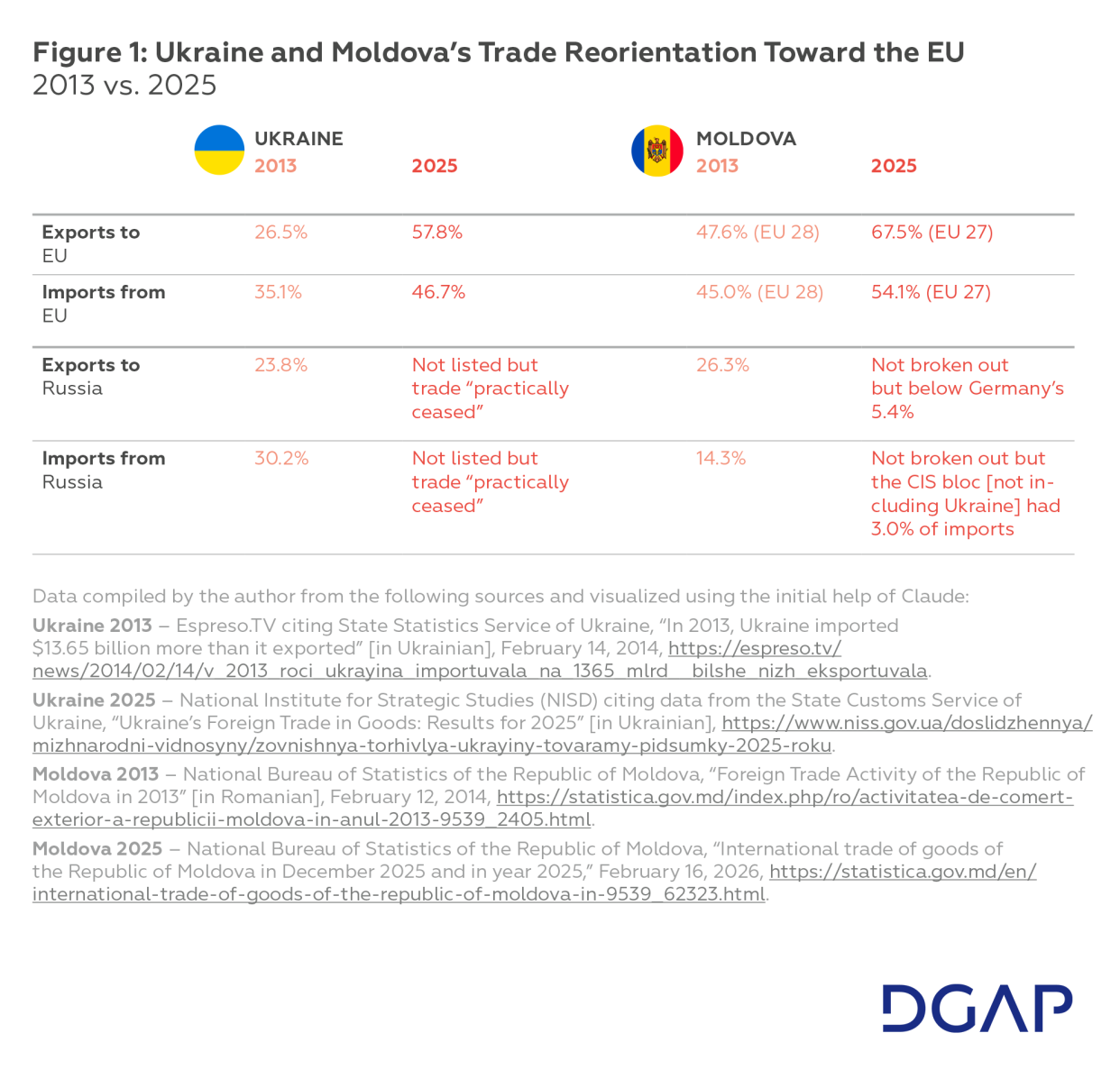
This structural shift has also fundamentally altered the dynamics within the Transnistrian region itself, making it dependent on the EU. According to recent data, almost 77 percent of its exports go to the EU and close to 46 percent of its imports are from the EU.
The war has accelerated Ukraine and Moldova’s structural decoupling from Russian energy systems. In March 2022, Ukraine and Moldova withdrew from the unified CIS electricity grid. The success of their subsequent emergency synchronization with the European Network of Transmission System Operators for Electricity (ENTSO-E) was an important step in their integration into the EU energy market. The decoupling process reached its peak in January 2025 when Ukraine chose to not extend the contract for the transit of Russian gas to the EU and Russia halted gas delivery to the Transnistrian region for more than a month. These developments demonstrate a broader transformation in the regional order: the economic connectivity and regulatory alignment of Ukraine and Moldova with the EU have stripped Russia of its traditional structural instruments of influence.
The Role of Regional Actors
Across the region, relationships between key external and regional powers have shifted significantly. Throughout Europe, Russia is now acknowledged as a direct threat, leading to the suspension of most bilateral multilateral cooperation frameworks. The risk of Russian drone attacks on NATO territory keeps governments on constant alert.
Türkiye shapes regional dynamics through hard power projection, diplomatic mediation, and economic engagement across the Black Sea and South Caucasus. Because Ankara’s foreign policy is highly transactional and interest-driven, it can maintain engagements with Russia, Ukraine, NATO, and regional states simultaneously. This makes Türkiye a central architect of the regional order – even as its actions frequently diverge from EU norms and values. Ankara expects to secure a prominent role in Ukraine’s reconstruction. While President Recep Tayyip Erdogan seeks to act as a primary mediator between Russia and Ukraine, he advocates for a pragmatic, interest-based regional framework that also includes Russia. Although Ukraine views Türkiye as a key partner and security actor, it has concerns about its continued relations with Russia.
China is positioning itself in Eastern Europe as an economic partner free from normative conditionality. It sees Eastern Europe not as primary strategic priority but as a market for opportunistic trade and infrastructure investment. China remains an important trading partner for both Ukraine and Moldova. It is Ukraine’s largest single trading partner with a high trade deficit (see Figure 2). Among its key imports are machinery, equipment, transport, chemicals, and fuel and energy products that are particularly necessary during wartime. Ukraine also purchases Chinese equipment for drone manufacturing.
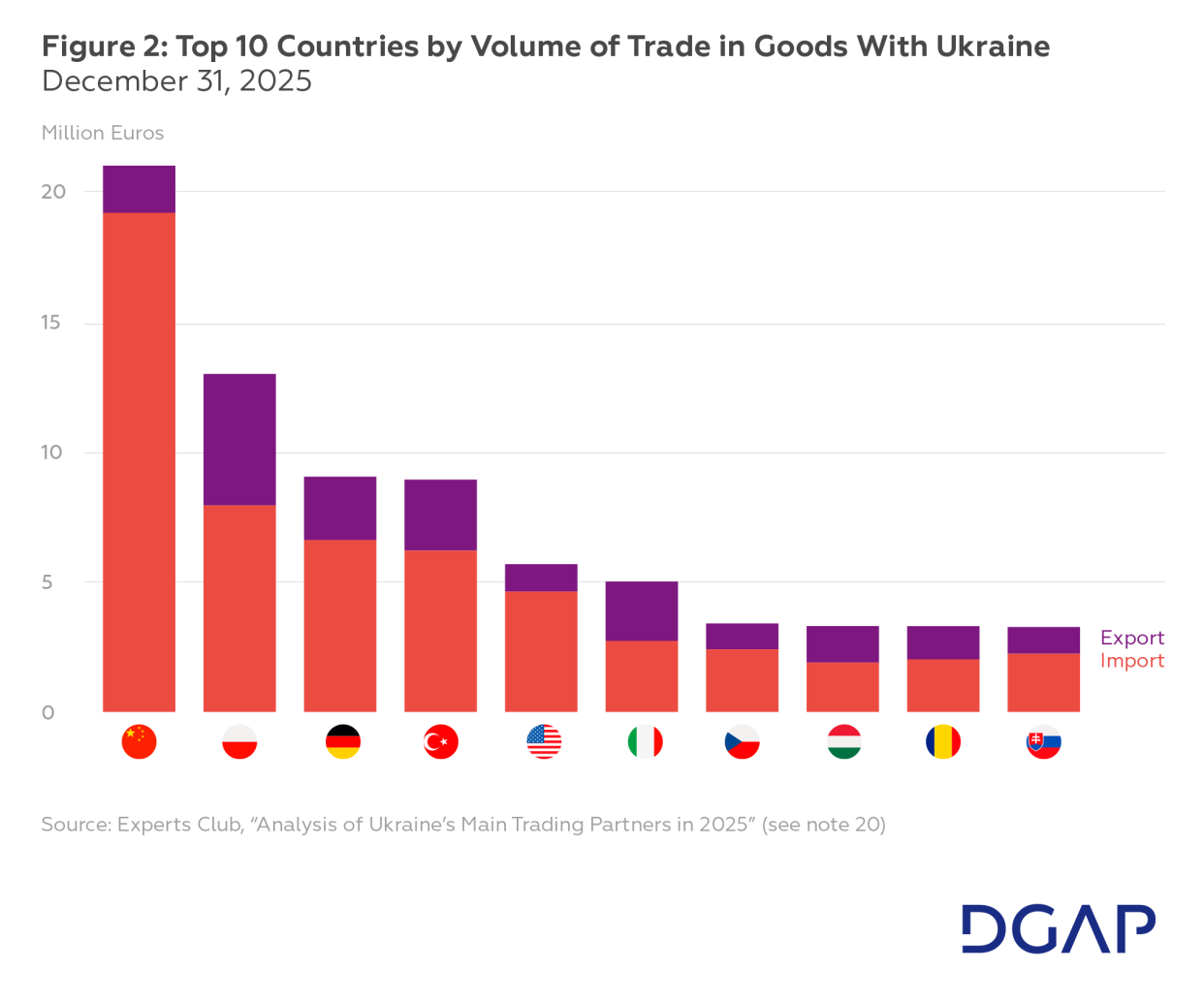
Overall, these trade dependencies are hard to replace. Therefore, even if experts see China as an ally of Russia, the country is likely to continue to play a key role in the region – also in reconstruction.
Moldova’s relations with China also run on a high trade deficit. Chinese exports outpace Moldovan exports by 47 times. The Moldovan government, aiming for more cooperation, has increased engagement with China. Hence, the role of China might become even bigger with trade asymmetries increasing.
The United States now takes an increasingly transactional and interest-driven approach to the region. The 2025 US-Ukraine Critical Minerals Agreement, which established a joint investment fund tying the future extraction of Ukraine’s strategic resources to American financial and security commitments, is a prime example of this. Although the United States lacks a coherent long-term strategy for the region, it remains a key security actor there and continues to provide intelligence and arms sales through NATO to Ukraine, as well as security cooperation and interest in joint drone production. However, the nature of US involvement is unpredictable.
In Moldova, the United States is particularly engaged in providing security support related to protecting the energy and cyber sectors and countering hybrid threats. One notable example is its funding of the Straseni-Gutinas transmission line project, a $130 million initiative to connect Moldova’s electric grid to Romania’s. Ultimately, though American involvement remains critical, it is increasingly governed by material interests rather than shared norms.
The EU’s Role: Conclusions and Recommendations
Russia’s full-scale invasion of Ukraine destroyed the post-Cold War security architecture in Eastern Europe, ending the era in which Ukraine and Moldova existed as a geopolitical “gray zone.” Although Ukraine is fragile, it has spent the intervening years transitioning into a security actor that shapes regional dynamics, redefines EU enlargement, and accelerates decoupling from Russian influence across all sectors. A weakened Russia now acts as a spoiling power in the region rather than a hegemon.
The EU and NATO have become key actors in regional stability. NATO is a key security provider, but – thanks to US shifts and unpredictability – its role for the EU has become questionable. The United States remains an essential security pillar although it has transformed from a being a normative guarantor to a transactional partner.
The Black Sea has reemerged as a central geopolitical space where middle powers play important roles. Türkiye is a security actor there in addition to being more active in the larger neighborhood. China is present economically, and its role can increase with trade.
These developments have also changed the EU’s policy and engagement with the region. Leaders in Brussels and EU member states have demonstrated unprecedented agility through rapid energy synchronization, trade integration, and adjustment of candidate status. The EU has deployed concrete security instruments, such as the European Defense Industry Program (EDIP) and the European Defense Innovation Office in Kyiv (EUDIO), to support Ukraine. Yet, the EU’s long-term credibility depends on its ability to maintain unity, withstand external hybrid attacks, and act strategically. In an increasingly volatile global order, anchoring Ukraine and Moldova firmly within the EU architecture is the prerequisite for European security and stability. The EU can do so by:
- Ensuring credible and timely EU accession through gradual integration. Bringing in the frontline experience of Ukraine and the institutional adaptation of both countries in such a way could lead to innovation and adaptation of institutions. Otherwise, the window of opportunity might close. The EU would then become one of the more prominent actors present in the region rather than the key partner.
- Ensuring that candidate states continue to strictly align with rule-of-law standards.
- Maintaining uninterrupted military, financial, and diplomatic backing, ensuring that any negotiated settlement provides security guarantees.
- Expanding EU defense industrial capacity while directly embedding Ukrainian warfare expertise into European defense initiatives.
- Reevaluating the EaP to reflect the new geopolitical reality and divergence in the region.
- Countering Russian hybrid activities that target Ukrainian refugees through communication and supporting their integration.
This paper is part of DGAP’s Eastern Partnership Think Tank Network project, which is supported by the European Commission. The views and opinions expressed in it are those of the author and do not necessarily reflect those of the European Union.
The author wishes to thank Leo Wigger of DGAP and Stepan Rusyn of the Transatlantic Dialogue Center for their feedback – with special thanks to Stefan Meister of DGAP for his extensive comments and research input – that significantly strengthened this text.