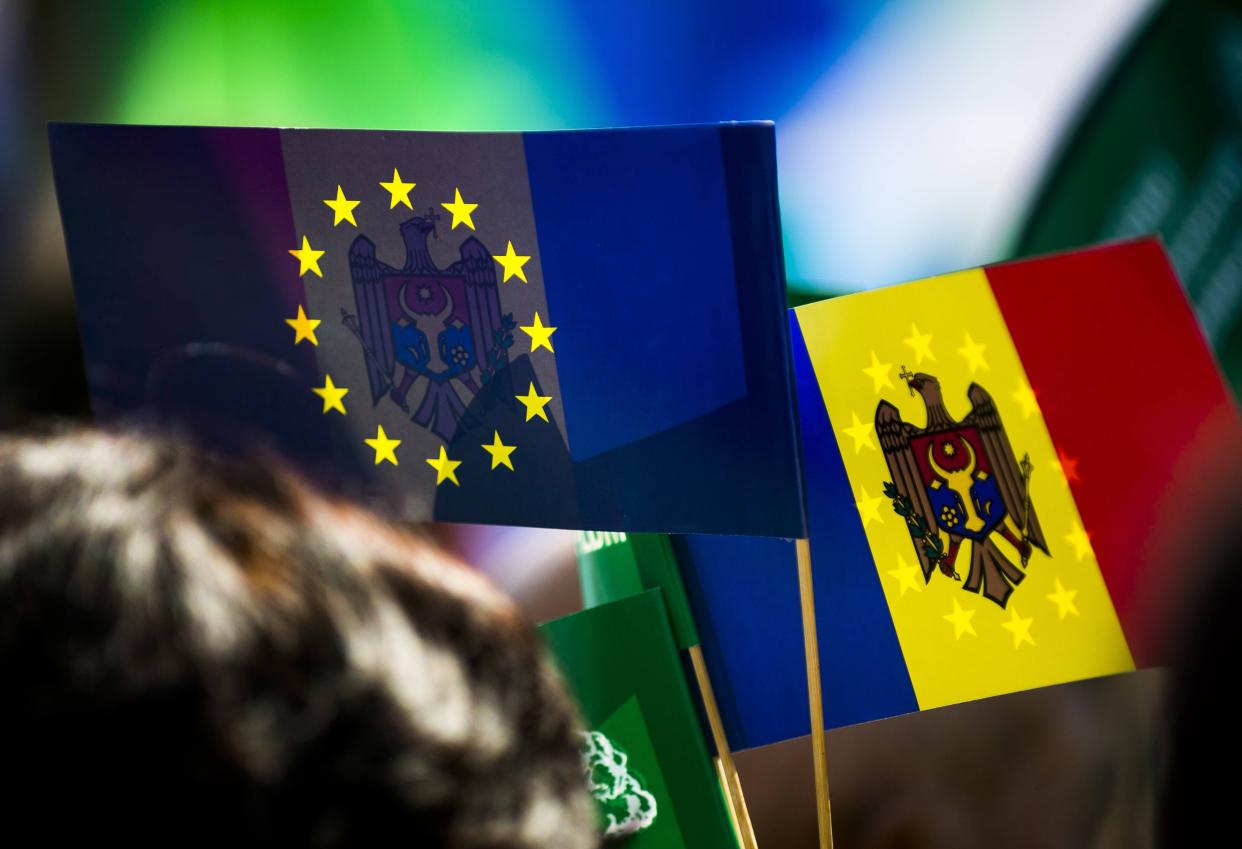
Since gaining independence in 1991, Moldova has struggled to set up independent institutions in a context of pervasive corruption and a compromised judiciary. Moldova had coalition governments after 2009 that proclaimed to be pro-European, but systemic corruption and problems with the judiciary and the rule of law persisted. Moldova signed the Association Agreement and DCFTA in 2014; numerous reforms were passed under EU conditionality, but most were not implemented. These ‘pro-European’ coalitions culminated in the Plahotniuc era from 2015 to 2019, a textbook example of state capture. These years are infamous for ‘Theft of the Century’ high-level corruption, political control of the judiciary and an overall decline in the rule of law. The period saw mass demonstrations versus the corrupt elite against a background of captured media, a hijacked state apparatus and pervasive impunity.
In 2020 Maia Sandu won the presidential election, and in 2021 her Party of Action and Solidarity (PAS) won an absolute majority in parliament. PAS came to power promising reforms: eradicating corruption, strengthening the rule of law and the judiciary and pursuing a pro-European agenda. Moldova’s rule of law has improved measurably since then, although improvements remains slow and uneven across institutions. This is also due to a complex political landscape. The PAS government had a highly challenging start with the compounding effects of the COVID-19 pandemic, the severe energy crisis of autumn 2021 and Russia's full-scale invasion of Ukraine in winter 2022. The government mostly operated in a crisis-response mode, focusing on its immediate priorities: the massive inflow of Ukrainian refugees, gas and energy shortages, false-flag operations in the Transnistrian region and ongoing national and regional security concerns.
Moldova followed Ukraine’s path in applying for EU membership. It received EU candidate status in June 2022, accompanied by nine specific reform steps. Following a positive assessment, Moldova was invited to open accession talks with the EU in June 2024, and organised a constitutional referendum over joining the EU in October that year. The referendum passed with a narrow result of 50.35 per cent, a close margin that highlighted the significant scale of Russian hybrid interference. Strong Russian interference continued in the parliamentary elections in 2025 in which PAS retained its single-party majority.
Recent years have seen an overall improvement in the fight against corruption, judicial reform and the rule of law; this has resulted in an overall increase in primary institutional resilience, as defined by the RESILIO-ACCESS project. However, the continuous crisis mode has led to a centralisation of power within PAS and to limited public consultation processes. There has also been a divergence between technical progress and domestic perception. While the European Commission Report and OECD Rule of Law report assess an overall improvement, some rule-of-law and corruption indicators from 2025 have begun to slip slightly compared to 2024, specifically the Rule of Law score from the World of Justice Project. Moldova’s score in Transparency International’s Corruption Perception Index decreased from 43 to 42 out of 100 points, ranking the country at 80 out of 182 states covered by the index. Nevertheless, overall assessments show a clear positive trend since 2019.
Some of the state measures linked to fighting hybrid threats could be assessed as intervening with fundamental democratic freedoms. These include excluding political parties through emergency decrees just days before elections, as with the Sansa party – affiliated with oligarch Ilan Shor – at local elections in 2023. And in 2025 two parties were removed from the electoral list just two days before the parliamentary elections, due to financial irregularities and affiliations with Russia. While the government justified these extraordinary measures by the intense time pressure to respond to asymmetric attacks by Russia and its proxies, these measures did not align with good governance safeguards as they did not allow the eliminated parties to contest the decisions. There is also a constant structural tension between the demand for rapid reforms – particularly those linked to EU accession – and a consultative, inclusive and transparent policy-making process. A monitoring report on the last legislature (2021–2025) showed that only 18 percent of bills underwent public consultation by the Parliament.
This dynamic directly feeds into Russian disinformation narratives and creates a climate where media and civil society face growing polarisation. This can occasionally result in self-censorship to avoid being perceived as undermining the state’s pro-European path, while also trying to hold the government to account.
This report focuses on recent developments, particularly since 2021. Because the RESILIO-ACCESS model primarily relies on 2024 data baselines, this paper uses the model’s qualitative factors for reference – but builds upon the most recent 2025 and 2026 data provided by V-Dem, the World Justice Project, Freedom House, the Bertelsmann Transformation Index (BTI), Transparency International, European Commission reports and semi-structured interviews with local experts in Moldova. Most of the aggregated data excludes the breakaway Transnistrian region due to a lack of access and reliable information from the left bank of the Nistru River.
The effect of the EU integration process
The Moldovan government has shown a lot of will and motivation to bring Moldova into the EU and implement relevant reforms, and EU integration has been one of the strongest external drivers of Moldova’s rule-of-law resilience and the reforms linked to the rule of law. But the high pace of reforms created by the EU accession process has also put pressure on government institutions to implement changes and maintain institutional bureaucracy while facing hybrid warfare, multiple crises, poverty and regional instability. The speed of the process and the ambition of the pace of reform risk creating hasty, under-consulted reforms that are passed on paper but not enforced. Reforms are being legislated at high speed to maintain accession momentum, and the process often leaves a wide gap between legislation and implementation. Increasing public support for reforms will be crucial.
Moldova’s EU accession process and its pro-EU government secured a commitment of a €1.8bn Growth Plan, support against hybrid threats through the EU Partnership Mission and a Rapid Response Mechanism for elections. This serves as direct evidence of the EU’s support for Moldova’s integration and strengthens resilience. EU-conditionality and support for the current PAS government have been a strong lever for Moldova’s rule-of-law resilience. It remains a priority that Moldova preserves a deliberative process, includes consultation and does not cut corners. Otherwise the reform process risks alienating people and creating a misleading image of the EU as endorsing practices out of line with rule-of-law standards. The EU must balance supporting Moldova’s EU integration for geopolitical reasons with ensuring that the process remains merit-based with a long-term vision for Moldovan democracy. The EU’s own credibility concerning when and how to integrate Moldova remains crucial. Without agreement among the Member States, reform momentum might be lost and the trust of the Moldovan population in the EU integration process might erode.
Moldova is also coupled with Ukraine in the accession process. Chisinau is not officially advocating for decoupling, but there is a concern that it will not be able to advance if Member States block Ukraine’s advancement. As a much smaller country, many of the issues raised by Member States over Ukraine's EU accession (particularly around economic and agricultural impacts) do not apply to Moldova in the same way. And the timing before elections in Member States in 2027 makes for a narrow window of opportunity. But Ukraine is a strategic and security partner for Chisinau; decoupling could create political tensions and risk leaving Ukraine in a geopolitical grey zone which will be used by Russia. This creates a strategic dilemma for Moldova.
Please find the full report by Anastasia Pociumban, originally published by the Institut für Europäische Politik (IEP), here.