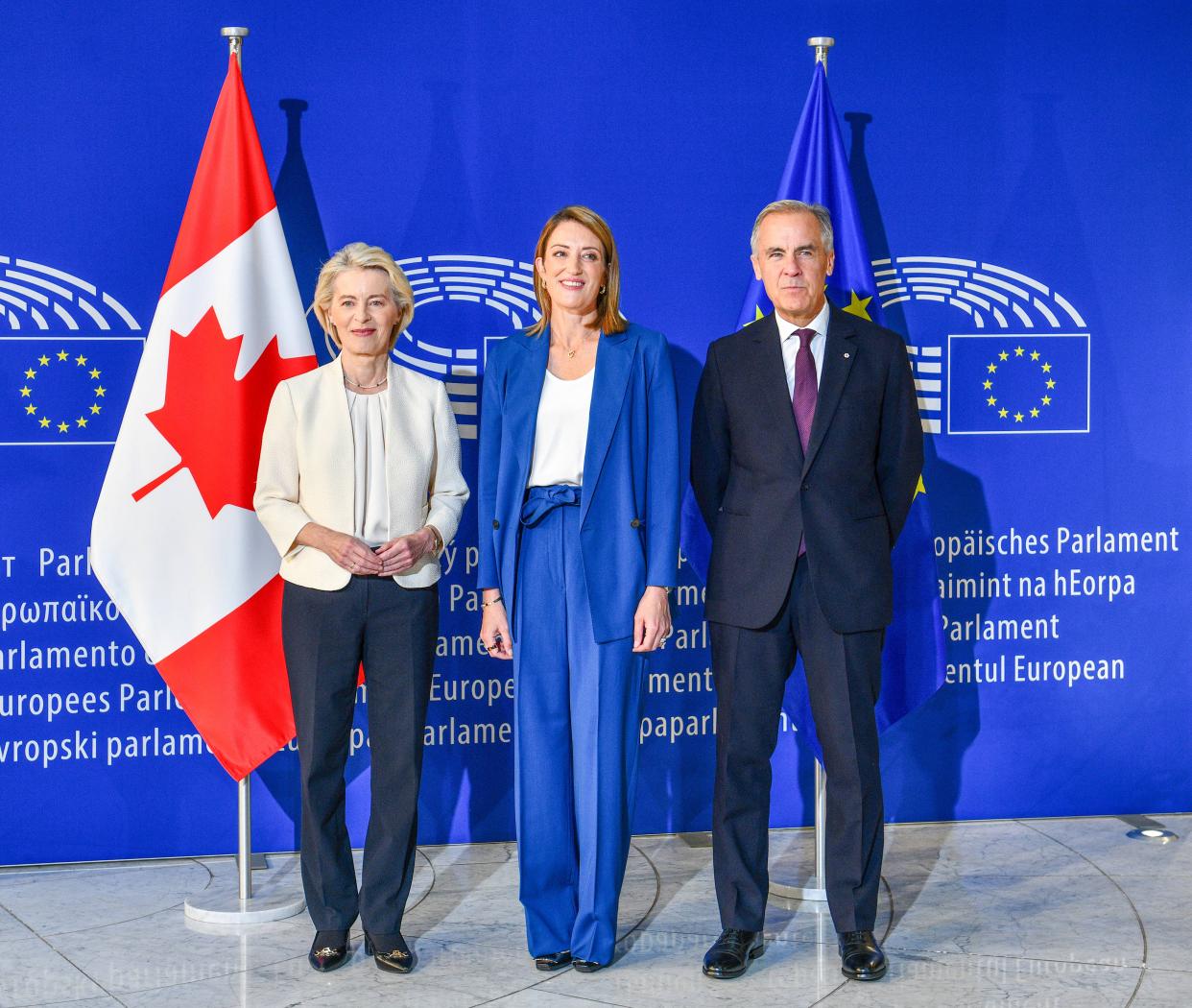
On Wednesday, Commission President Ursula von der Leyen pitched the idea of working towards welcoming Canada as a first “associate member” of the European Union.
The announcement – presented to great fanfare – will ring a bell in Kyiv, where German Chancellor Friedrich Merz recently proposed the “associate membership” label as a special membership track for Ukraine. Among other provisions, this would allow Ukraine to participate in EU Council formations and would bring it under the EU’s security umbrella (Article 42.7 TEU).
Both offers show the EU is increasingly seeking concepts below the level of fully fledged Union membership and reflect a normative discussion about the closer integration of non-EU members – bearing in mind that the bloc has not really been a champion in this respect over the past decade. After the negative referendum in Iceland, the EU is in desperate need of a more positive integration narrative. Although actual membership for Canada is, for various reasons, out of the question.
For Canadians, admission to the European Union is out of the question. It would require implementing the entirety of the EU rulebook, becoming part of its structures and entering the Internal Market. And since it is clearly not a European country, full membership is prevented by the EU Treaties.
Associate membership should rather be seen as a normative idea to bind the European Union and Canada closer together. It implies building upon the CETA trade agreement but also increasing the security partnership and people-to-people contact below administration level – including participation in EU programmes like Erasmus+ and Horizon.
This would go some way in fulfilling Carney’s now-trademark vision for cooperation between middle powers and, crucially, would paint the EU as an attractive partner. This latter objective is critical, in light of Iceland’s rejection and an enlargement process that seems intractably hamstrung by the reluctance of a few EU countries to open up the fold. Hence von der Leyen presented yet another variation on membership-lite – a PR win, if only they could pull it off.
Yet it is precisely this added value conferred by “associate membership” that Ukraine takes issue with. Because while Ottawa might read opportunity, Kyiv sees a rebuff. Ukraine is not seeking an added-value partnership; it wants credible security guarantees that can finally wrench it away from Russia’s sphere of political influence.
As such, associate membership is only a half-baked proposition compared to full integration into the European Union. Kyiv will take great interest in Canada’s case, given the security provisions it receives from its North American partner. But there is no question that it will accept a similar arrangement.
Nothing short of full membership – including full access to the Single Market and credible security guarantees within the EU framework – will suffice. Von der Leyen’s SOTEU surprise has only muddied the waters.
